An increase in preload causes a/an ________ in stroke volume in accordance with the ________ law. An increase in afterload causes a/an ________ in stroke volume. An increase in contractility causes a/an ________ in stroke volume.
Ch. 17 The Cardiovascular System I: The Heart
Amerman3rd EditionHuman Anatomy & PhysiologyISBN: 9780138247201, 9780138247928, 9780138201814Not the one you use?Change textbook
Chapter 17, Problem L21a
A birth defect called transposition of great vessels results in the pulmonary trunk emanating from the left ventricle and the aorta stemming from the right ventricle.
Which ventricle is thicker-walled, and why?
Verified step by step guidance1
Understand the anatomy of the heart: The heart has four chambers—two atria and two ventricles. The left ventricle pumps oxygenated blood to the entire body via the aorta, while the right ventricle pumps deoxygenated blood to the lungs via the pulmonary trunk.
Recognize the functional differences between the ventricles: The left ventricle must generate higher pressure to push blood through the systemic circulation, which includes all the organs and tissues of the body. The right ventricle, on the other hand, only needs to pump blood to the lungs, which is a much shorter and lower-pressure circuit.
Relate the structural adaptation to function: Because the left ventricle needs to generate higher pressure, its walls are thicker and more muscular compared to the right ventricle. This structural difference allows the left ventricle to handle the demands of systemic circulation.
Apply this knowledge to the defect described: In transposition of the great vessels, the pulmonary trunk is connected to the left ventricle, and the aorta is connected to the right ventricle. Despite the abnormal connections, the left ventricle remains thicker-walled because its structure is determined by its role in generating high pressure, not by the vessels it is connected to.
Conclude the reasoning: The left ventricle is thicker-walled because it is designed to pump blood under high pressure to the systemic circulation, which requires more muscular walls to overcome the resistance of the entire body’s blood vessels.

Verified video answer for a similar problem:
This video solution was recommended by our tutors as helpful for the problem above.
Was this helpful?
Key Concepts
Here are the essential concepts you must grasp in order to answer the question correctly.
Ventricular Structure
The heart consists of four chambers, with the left and right ventricles being responsible for pumping blood to different parts of the body. The left ventricle has a thicker muscular wall compared to the right ventricle because it needs to generate higher pressure to pump oxygenated blood throughout the systemic circulation, while the right ventricle pumps deoxygenated blood to the lungs at lower pressure.
Recommended video:
Guided course
Structure of the Eyeball Example 1
Pressure Dynamics in the Heart
The pressure dynamics in the heart are crucial for understanding the function of the ventricles. The left ventricle must overcome the systemic vascular resistance to deliver blood effectively, resulting in a thicker wall to withstand and generate this higher pressure. In contrast, the right ventricle operates against the lower resistance of the pulmonary circulation, allowing it to have a thinner wall.
Recommended video:
Guided course
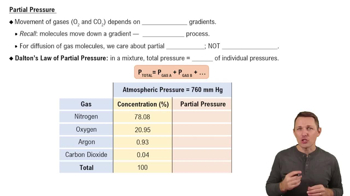
Partial Pressure
Transposition of Great Vessels
Transposition of the great vessels is a congenital heart defect where the positions of the pulmonary artery and aorta are switched. This condition leads to two separate circulatory systems: one for oxygen-poor blood and another for oxygen-rich blood, which can cause significant physiological challenges. Understanding this defect is essential for grasping the implications of ventricular wall thickness and function in this context.
Recommended video:
Blood Vessels
Related Practice
Textbook Question
2
views
Textbook Question
Which of the following statements is false?
a. The sympathetic nervous system releases epinephrine and norepinephrine, which are positive chronotropic and inotropic agents.
b. The endocrine system regulates cardiac output through chronotropic and inotropic hormones and through hormones that regulate water balance.
c. The parasympathetic nervous system releases acetylcholine and epinephrine, which are strongly negative inotropic agents.
d. Factors such as electrolyte concentrations, body temperature, and age all affect cardiac output.

2
views
Textbook Question
Cardiac output is equal to:
a. End-diastolic volume minus end-systolic volume.
b. Heart rate multiplied by stroke volume.
c. Stroke volume divided by end-diastolic volume.
d. Heart rate multiplied by preload.