
Ch. 17 The Cardiovascular System I: The Heart
Amerman- Human Anatomy & Physiology 3e
Amerman3rd EditionHuman Anatomy & PhysiologyISBN: 9780138247201, 9780138247928, 9780138201814Not the one you use?Change textbook
Chapter 17, Problem L3.2

A newer drug, ivabradine, lowers the heart rate by blocking the nonselective HCN cation channels. Why would this action decrease the heart rate? Would this drug have an effect on pacemaker cells, contractile cells, or both? Explain.

Verified step by step guidance
1
Understand the role of HCN (Hyperpolarization-activated Cyclic Nucleotide-gated) channels: These channels are responsible for generating the pacemaker potential in the sinoatrial (SA) node by allowing the influx of sodium (Na⁺) and potassium (K⁺) ions. This influx contributes to the gradual depolarization of pacemaker cells, leading to the initiation of action potentials that regulate heart rate.
Recognize the mechanism of ivabradine: Ivabradine blocks HCN channels, reducing the influx of cations (Na⁺ and K⁺). This slows the rate of depolarization in pacemaker cells, delaying the generation of action potentials and ultimately lowering the heart rate.
Determine the type of cells affected: Since HCN channels are primarily found in pacemaker cells of the SA node, ivabradine specifically affects pacemaker cells rather than contractile cells. Contractile cells rely on action potentials generated by pacemaker cells to initiate contraction, but they do not directly use HCN channels.
Explain why the heart rate decreases: By slowing the depolarization of pacemaker cells, ivabradine increases the time between action potentials. This reduces the frequency of electrical signals sent to contractile cells, thereby lowering the heart rate.
Summarize the drug's effect: Ivabradine selectively targets pacemaker cells in the SA node by blocking HCN channels, leading to a slower heart rate without directly affecting contractile cells. This makes it useful for conditions where heart rate reduction is desired, such as in patients with tachycardia or heart failure.

Verified video answer for a similar problem:

This video solution was recommended by our tutors as helpful for the problem above.
Was this helpful?

Key Concepts

Here are the essential concepts you must grasp in order to answer the question correctly.

HCN Cation Channels

Hyperpolarization-activated cyclic nucleotide-gated (HCN) channels are ion channels that allow the flow of sodium and potassium ions. They play a crucial role in generating the pacemaker potential in cardiac pacemaker cells, which is essential for initiating heartbeats. By blocking these channels, ivabradine reduces the influx of ions that contribute to depolarization, leading to a slower heart rate.
Recommended video:
04:34
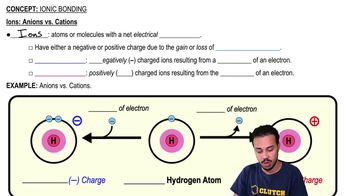
Ions: Anions vs. Cations

Pacemaker Cells

Pacemaker cells, primarily located in the sinoatrial (SA) node of the heart, are specialized cells that generate electrical impulses to regulate heart rhythm. These cells have the unique ability to spontaneously depolarize, which initiates the heartbeat. Since ivabradine affects HCN channels, it directly influences the activity of pacemaker cells, resulting in a decreased heart rate.
Recommended video:
Guided course
6:36
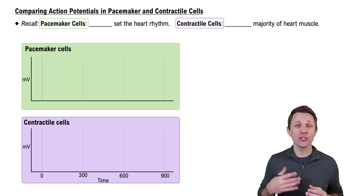
Comparing Action Potentials in Pacemaker and Contractile Cells

Contractile Cells

Contractile cells, or cardiomyocytes, are responsible for the contraction of the heart muscle. Unlike pacemaker cells, they do not initiate impulses but respond to them. While ivabradine primarily affects pacemaker cells by slowing the heart rate, it does not directly impact the contractile cells' function, as their contraction is regulated by different mechanisms, including calcium ion influx.
Recommended video:
Guided course
6:36
Comparing Action Potentials in Pacemaker and Contractile Cells
Related Practice
Textbook Question

The pericardial cavity is located between:

a. The parietal pericardium and the fibrous pericardium.

b. The fibrous pericardium and the myocardium.

c. The parietal pericardium and the visceral pericardium.

d. The epicardium and the endocardium.

2
views
Textbook Question

How do pacemaker cardiac muscle cells differ from contractile cardiac muscle cells? What is autorhythmicity?

1
views
Textbook Question

Which of the following statements is true?

a. The tricuspid valve is located between the right atrium and the right ventricle.

b. The mitral valve is located between the pulmonary veins and the left atrium.

c. The pulmonary valve is located between the pulmonary artery and the pulmonary veins.

d. The aortic valve is located between the right ventricle and the aorta.

3
views
Textbook Question

Mr. Watson has been diagnosed with mitral insufficiency, or a malfunctioning mitral valve, which causes the valve to not close properly. Predict the signs and symptoms you might expect from a disease of this valve. What would happen to the patient's stroke volume and cardiac output? Explain. What might help improve his cardiac output?

2
views
Textbook Question

An experimental toxin makes the refractory period of cardiac muscle cells equal in length to that of skeletal muscle fibers. Predict the consequences of this toxin.

1
views
Textbook Question

You are an athletic trainer who is working with someone planning to run a marathon. Your trainee tells you to give him a workout that will make his heart 'beat faster than ever before.' What do you tell him about the effects of too rapid a heart rate?

3
views