


Ch. 15 The Special Senses
Amerman- Human Anatomy & Physiology 3e
Amerman3rd EditionHuman Anatomy & PhysiologyISBN: 9780138247201, 9780138247928, 9780138201814Not the one you use?Change textbook
Chapter 15, Problem L3.4

Suppose the round window in your middle ear became very stiff. What effect would this have on hearing, and why?

Verified step by step guidance
1
Understand the role of the round window in the middle ear: The round window is a flexible membrane that helps dissipate sound wave energy from the cochlea. It works in conjunction with the oval window to allow fluid movement within the cochlea, which is essential for transmitting sound vibrations to the auditory receptors.
Recognize the importance of fluid movement in the cochlea: When sound waves enter the cochlea via the oval window, they create pressure waves in the cochlear fluid. The round window's flexibility allows these pressure waves to move freely, ensuring proper stimulation of the hair cells in the organ of Corti, which are responsible for converting mechanical vibrations into electrical signals for the brain.
Analyze the effect of stiffness in the round window: If the round window becomes stiff, it would restrict the movement of the cochlear fluid. This would impair the transmission of sound wave energy, reducing the ability of the hair cells to detect vibrations effectively.
Consider the impact on hearing: With limited fluid movement, the mechanical vibrations would not be properly converted into electrical signals, leading to hearing loss or difficulty perceiving sound, especially at certain frequencies.
Summarize the physiological consequence: The stiffness of the round window would disrupt the normal mechanics of the middle and inner ear, ultimately impairing the auditory process and reducing hearing sensitivity.

Verified video answer for a similar problem:

This video solution was recommended by our tutors as helpful for the problem above.
Was this helpful?

Key Concepts

Here are the essential concepts you must grasp in order to answer the question correctly.

Round Window Function

The round window is a membrane-covered opening in the cochlea of the inner ear that plays a crucial role in hearing. It allows for the displacement of fluid within the cochlea when sound waves enter through the oval window. If the round window becomes stiff, it would hinder this fluid movement, leading to impaired sound transmission and reduced hearing sensitivity.
Recommended video:
06:04
Functional Groups

Sound Wave Transmission

Sound waves are mechanical vibrations that travel through air and other mediums. In the ear, these waves are converted into mechanical energy that moves the ossicles and creates pressure changes in the cochlear fluid. A stiff round window disrupts this process, preventing effective pressure equalization and sound wave propagation, which can result in diminished auditory perception.
Recommended video:
Guided course
7:54
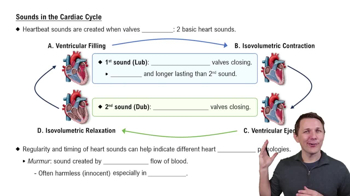
Sounds in the Cardiac Cycle

Impedance Matching

Impedance matching refers to the process by which the ear optimally transfers sound energy from the air (low impedance) to the fluid of the cochlea (high impedance). The round window's flexibility is essential for this matching, as it allows for the necessary movement of fluid. Stiffness in the round window would increase impedance mismatch, leading to a significant loss of sound energy and poorer hearing ability.
Recommended video:
Guided course
3:41
Cardiac Cycle Example 2