
Ch. 14 The Autonomic Nervous System and Homeostasis
Amerman- Human Anatomy & Physiology 3e
Amerman3rd EditionHuman Anatomy & PhysiologyISBN: 9780138247201, 9780138247928, 9780138201814Not the one you use?Change textbook
Chapter 14, Problem 10

________ receptors are located on parasympathetic postganglionic neurons, and________ receptors are located on parasympathetic target cells.

Verified step by step guidance
1
Step 1: Understand the context of the question. The parasympathetic nervous system is part of the autonomic nervous system, which controls involuntary functions. It involves two types of neurons: preganglionic and postganglionic neurons, and their associated receptors.
Step 2: Recall that parasympathetic postganglionic neurons have receptors that respond to neurotransmitters released by preganglionic neurons. These receptors are typically nicotinic acetylcholine receptors, which are ionotropic and respond to acetylcholine.
Step 3: Identify the receptors located on parasympathetic target cells. These cells receive signals from postganglionic neurons, which release acetylcholine. The receptors on these target cells are muscarinic acetylcholine receptors, which are metabotropic and mediate various physiological responses.
Step 4: Differentiate between nicotinic and muscarinic receptors. Nicotinic receptors are found on postganglionic neurons and are involved in signal transmission, while muscarinic receptors are found on target cells and mediate the effects of the parasympathetic nervous system.
Step 5: Summarize the answer: Nicotinic receptors are located on parasympathetic postganglionic neurons, and muscarinic receptors are located on parasympathetic target cells.

Verified video answer for a similar problem:

This video solution was recommended by our tutors as helpful for the problem above.
Was this helpful?

Key Concepts

Here are the essential concepts you must grasp in order to answer the question correctly.

Cholinergic Receptors

Cholinergic receptors are a type of receptor that responds to the neurotransmitter acetylcholine. They are classified into two main types: nicotinic and muscarinic receptors. Nicotinic receptors are found on the postganglionic neurons of the parasympathetic nervous system, while muscarinic receptors are located on the target cells that respond to parasympathetic stimulation.
Recommended video:
2:47
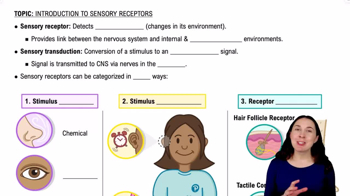
Sensory Receptors

Parasympathetic Nervous System

The parasympathetic nervous system is one of the two main divisions of the autonomic nervous system, responsible for promoting 'rest and digest' functions. It conserves energy by slowing down the heart rate, increasing intestinal and gland activity, and relaxing sphincter muscles. Understanding its role is crucial for identifying how cholinergic receptors function in the body.
Recommended video:
1:56
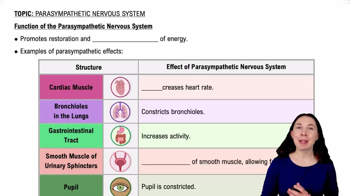
Function of the Parasympathetic Nervous System

Neurotransmission

Neurotransmission is the process by which signaling molecules called neurotransmitters are released by neurons and bind to receptors on target cells, leading to a response. In the context of the parasympathetic nervous system, acetylcholine is the primary neurotransmitter involved, facilitating communication between neurons and their target organs through cholinergic receptors.
Recommended video:
2:30
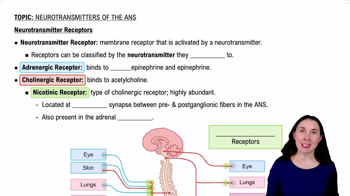
Neurotransmitter Receptors
Related Practice
Textbook Question

Match the following neurotransmitters with their correct description.    


_____ GABA    

_____ Dopamine     

_____ Substance P     

_____ Acetylcholine    

_____ Glutamate     

_____ Endorphins     

_____ Norepinephrine


a. Neuropeptide involved in transmission of pain

b. Neurotransmitter released at the neuromuscular junction

c. Major excitatory neurotransmitter in the brain

d. Major inhibitory neurotransmitter in the brain

e. Neuropeptide involved in relief of pain

f. Catecholamine involved in the autonomic nervous system

g. Catecholamine involved in movement and behavior

1
views
Textbook Question

Mark the following statements as true or false. If a statement is false, correct it to make a true statement.

b. Sympathetic stimulation increases sweat secretion.

7
views
Textbook Question

Mark the following statements as true or false. If a statement is false, correct it to make a true statement.

d. Sympathetic tone controls the resting rate of the heart.

2
views
Textbook Question

Mark the following statements as true or false. If a statement is false, correct it to make a true statement.

c. The parasympathetic nervous system releases acetylcholine onto all its synapses.

2
views
Textbook Question

Parasympathetic ganglia are typically:

a. Located along the spinal cord

b. Located near their target cells

c. Located within the central nervous system

d. Parasympathetic neurons do not synapse in ganglia

1
views
Textbook Question

Central nervous system control over the ANS is mediated by:

a. The reticular formation

b. The hypothalamus

c. The thalamus

d. Both a and b

1
views