
Ch. 10 Muscle Tissue and Physiology
Amerman- Human Anatomy & Physiology 3e
Amerman3rd EditionHuman Anatomy & PhysiologyISBN: 9780138247201, 9780138247928, 9780138201814Not the one you use?Change textbook
Chapter 10, Problem 5

What is the basic mechanism of contraction at the level of myofilaments?

Verified step by step guidance
1
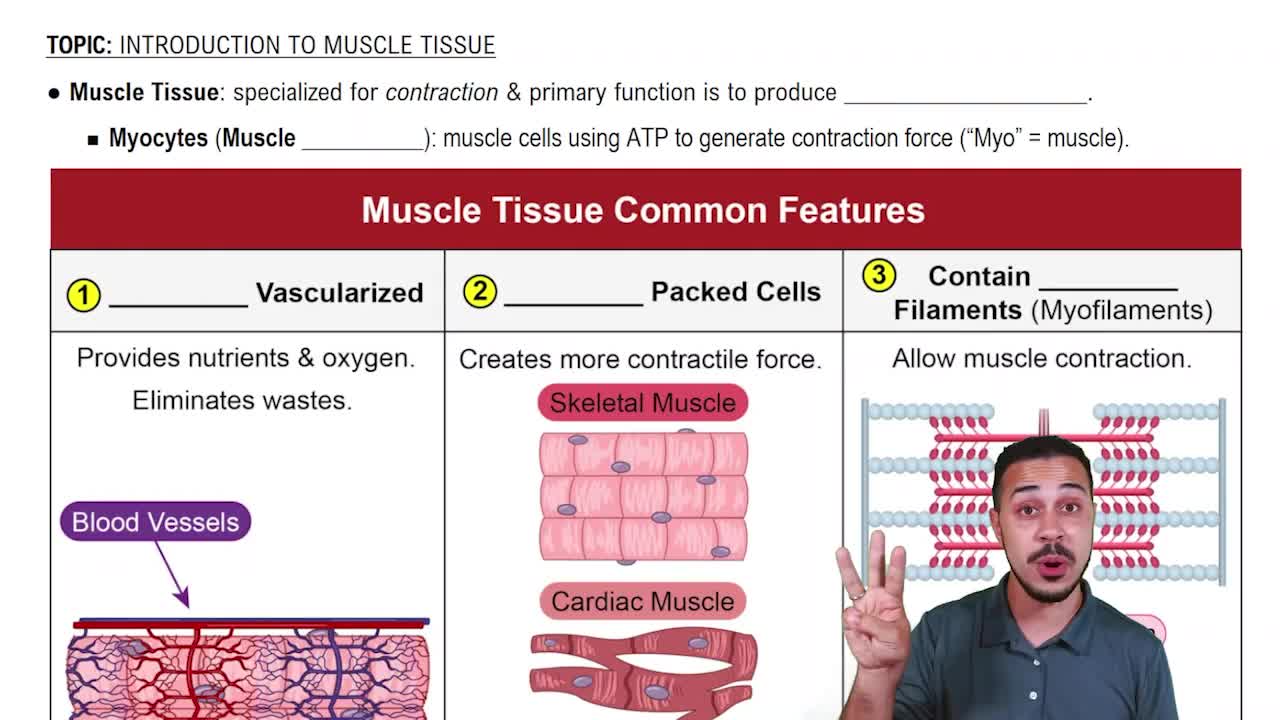
Understand that muscle contraction occurs at the level of the sarcomere, the functional unit of a muscle fiber, which contains thick filaments (myosin) and thin filaments (actin). The interaction between these filaments is responsible for contraction.
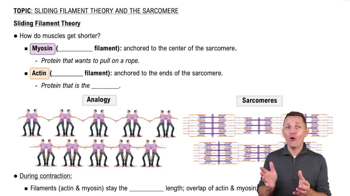
Learn about the sliding filament theory, which explains that contraction occurs when the thin filaments (actin) slide past the thick filaments (myosin), shortening the sarcomere without changing the length of the filaments themselves.
Recognize the role of calcium ions (Ca²⁺) in initiating contraction. When a muscle is stimulated, Ca²⁺ is released from the sarcoplasmic reticulum and binds to troponin, a regulatory protein on the thin filament. This causes a conformational change in tropomyosin, exposing the myosin-binding sites on actin.
Understand the cross-bridge cycle: Myosin heads, which are energized by ATP hydrolysis, bind to the exposed sites on actin, forming cross-bridges. The myosin heads then pivot (power stroke), pulling the actin filaments toward the center of the sarcomere. ATP is required to detach the myosin heads and reset them for another cycle.
Recognize that contraction continues as long as Ca²⁺ levels remain elevated and ATP is available. When stimulation ceases, Ca²⁺ is actively pumped back into the sarcoplasmic reticulum, tropomyosin re-covers the binding sites on actin, and the muscle relaxes.

Verified video answer for a similar problem:

This video solution was recommended by our tutors as helpful for the problem above.
Was this helpful?

Key Concepts

Here are the essential concepts you must grasp in order to answer the question correctly.

Myofilaments

Myofilaments are the contractile proteins found within muscle fibers, primarily composed of actin (thin filaments) and myosin (thick filaments). These proteins interact to facilitate muscle contraction through a process known as the sliding filament theory, where myosin heads attach to actin filaments and pull them inward, shortening the muscle fiber.
Recommended video:
Guided course
04:47
Intro to Muscle Tissue

Sliding Filament Theory

The sliding filament theory explains how muscle contraction occurs at the molecular level. According to this theory, during contraction, myosin heads bind to actin filaments, forming cross-bridges. The myosin heads then pivot, pulling the actin filaments toward the center of the sarcomere, which is the basic unit of muscle contraction, resulting in muscle shortening.
Recommended video:
Guided course
6:26
Sliding Filament Theory

Calcium Ions and ATP

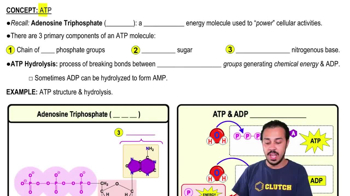
Calcium ions (Ca2+) and adenosine triphosphate (ATP) are crucial for muscle contraction. When a muscle is stimulated, calcium is released from the sarcoplasmic reticulum, enabling the binding of myosin to actin. ATP provides the energy required for the myosin heads to detach from actin and re-cock for another contraction cycle, ensuring continuous muscle activity.
Recommended video:
Related Practice
Textbook Question

Which of the following statements accurately describes the role of ATP in a muscle contraction?

a. ATP is directly responsible for the power stroke.

b. ATP moves troponin and tropomyosin away from actin.

c. ATP breaks the actin/myosin attachment and 'cocks' the myosin head.

d. ATP causes the myofilaments to shorten.

1
views
Textbook Question

Paola is a 3-year-old girl with a disease that reduces the ability of her mitochondria to generate ATP. Explain the specific effects of this disease on the ability of Paola's muscles to function properly. What other tissues and organs are likely to be especially affected by her disease, and why?

1
views
Textbook Question

Mr. Nasheed has cerebral palsy and suffers severe skeletal muscle spasms as a result of his condition. He is prescribed the drug dantrolene, which prevents the release of Ca2+ from the SR. Explain how this will treat his muscle spasms.

2
views
Textbook Question

Order the following events of excitation and excitation-contraction coupling. Put 1 by the first event, 2 by the second, and so on.

____ The motor end plate generates an end-plate potential.

____ The action potential spreads along the T-tubules, SR Ca2+ channels are pulled open, and Ca2+ floods the cytosol.

____ Acetylcholine binds to receptors on the motor end plate, and ligand-gated ion channels open.

____ Ca2+ bind troponin, which allows tropomyosin to move away from the actin active site, initiating a contraction cycle.

____ The action potential propagates through the sarcolemma and dives deeply into the cell along the T-tubules.

1
views
Textbook Question

A muscle fiber relaxes when:

a. The concentration of Ca2+ in the cytosol returns to resting levels.

b. The supply of ATP is exhausted.

c. Ca2+ flood the cytosol.

d. Acetylcholine is released from the axon terminal and the sarcolemma depolarizes.

1
views
Textbook Question

Match the following terms with the correct definition.      


____Z-disc     

____Sarcomere     

____A band     

____H zone     

____I band     

____M line


a. The dark band containing the entire length of the thick filament

b. The band of proteins in the middle of the H zone

c. The boundary between sarcomeres

d. The functional unit of contraction

e. The middle region of the A band containing only thick filaments

f. The light band containing only thin filaments

1
views