Ch. 7 The Skeletal System
Amerman - Human Anatomy & Physiology 2nd Edition
Amerman2nd EditionHuman Anatomy & PhysiologyISBN: 9780136873822Not the one you use?Change textbook
Chapter 7, Problem 12

Which of the following portions of the scapula articulates with the clavicle?


a. Coracoid process
b. Acromion
c. Spine
d. Glenoid cavity

Verified step by step guidance
1
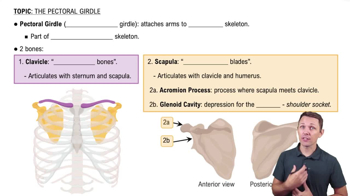
Step 1: Understand the anatomy of the scapula and its key features. The scapula, or shoulder blade, is a triangular bone that connects the humerus (upper arm bone) with the clavicle (collarbone). It has several important landmarks, including the coracoid process, acromion, spine, and glenoid cavity.
Step 2: Review the function of the clavicle. The clavicle is a long bone that serves as a strut between the shoulder blade and the sternum. It plays a role in stabilizing the shoulder and articulates with specific parts of the scapula.
Step 3: Identify the portion of the scapula that directly articulates with the clavicle. The acromion is a bony projection on the scapula that extends laterally and forms the highest point of the shoulder. It is the specific part of the scapula that connects to the clavicle at the acromioclavicular joint.
Step 4: Differentiate the acromion from other parts of the scapula. The coracoid process is another projection of the scapula, but it serves as an attachment point for muscles and ligaments rather than articulating with the clavicle. The spine is a ridge on the posterior side of the scapula, and the glenoid cavity is the socket that articulates with the head of the humerus.
Step 5: Conclude that the acromion is the correct answer based on its anatomical role in forming the acromioclavicular joint with the clavicle.

Verified video answer for a similar problem:

This video solution was recommended by our tutors as helpful for the problem above.
Video duration:
2m
Was this helpful?

Key Concepts

Here are the essential concepts you must grasp in order to answer the question correctly.

Scapula Anatomy

The scapula, or shoulder blade, is a flat, triangular bone located in the upper back. It has several important features, including the acromion, coracoid process, and glenoid cavity, which play crucial roles in shoulder mobility and stability. Understanding the anatomy of the scapula is essential for identifying its articulations with other bones, such as the clavicle.
Recommended video:
4:14
Clitoral Anatomy

Clavicle Articulation

The clavicle, or collarbone, is a long bone that connects the arm to the body. It articulates with the scapula at the acromion and with the sternum at the manubrium. This articulation is vital for shoulder function, as it allows for a wide range of arm movements and provides structural support to the shoulder girdle.
Recommended video:
Guided course
6:23
Pectoral Girdle

Shoulder Joint Function

The shoulder joint is a ball-and-socket joint formed by the glenoid cavity of the scapula and the head of the humerus. It is the most mobile joint in the body, allowing for a wide range of motion. The articulation between the scapula and clavicle at the acromion is crucial for maintaining the stability and function of the shoulder joint during various activities.
Recommended video:
08:43
Functional Joint Classifications