Ch. 6 Bones and Bone Tissue
Amerman - Human Anatomy & Physiology 2nd Edition
Amerman2nd EditionHuman Anatomy & PhysiologyISBN: 9780136873822Not the one you use?Change textbook
Chapter 6, Problem 14

Bone deposition is carried out by_____, which secrete the____ of the ECM by exocytosis. They facilitate the formation of the______of the ECM by secreting_____filled with calcium ions, enzymes, and ATP. Bone resorption is carried out by______ , which secrete_____and_____from their ruffled border.

Verified step by step guidance
1
Step 1: Understand the process of bone deposition. Bone deposition is the process by which new bone tissue is formed. This is primarily carried out by specialized cells called osteoblasts. These cells are responsible for secreting the organic components of the extracellular matrix (ECM), such as collagen, through the process of exocytosis.
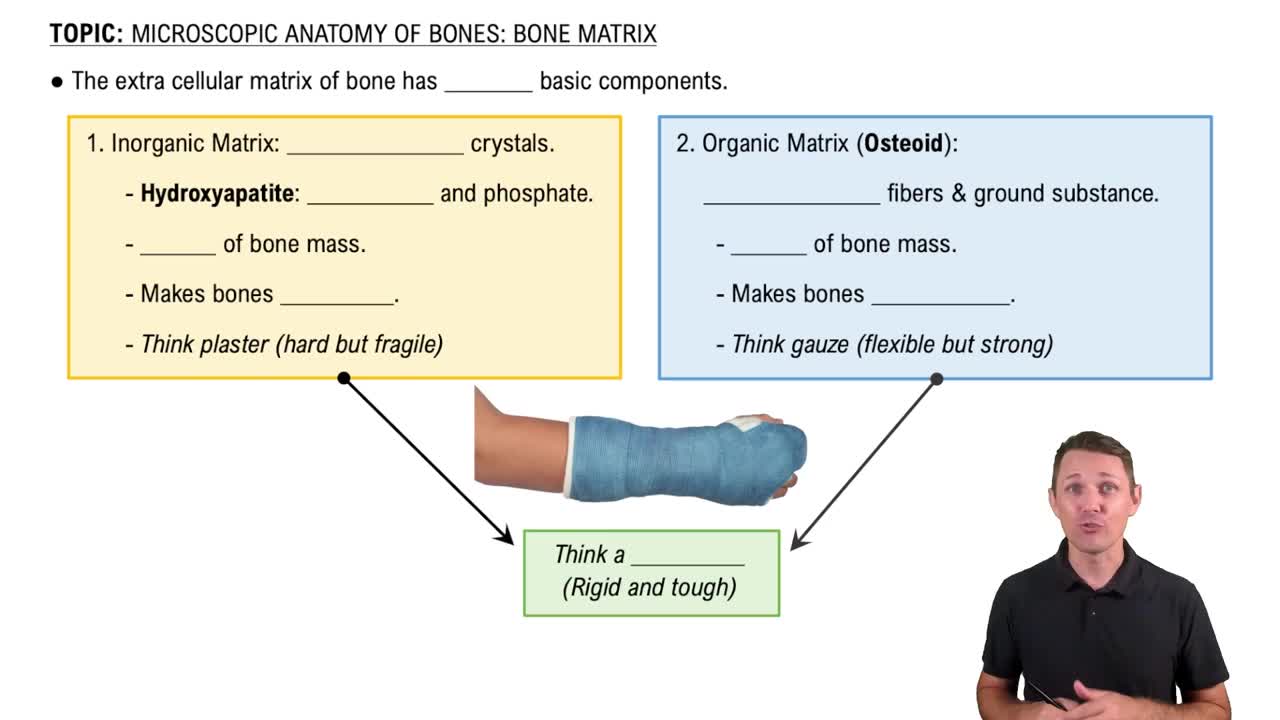
Step 2: Recognize the role of osteoblasts in mineralization. Osteoblasts facilitate the formation of the mineralized portion of the ECM by secreting vesicles filled with calcium ions, enzymes, and ATP. These vesicles help initiate the crystallization of hydroxyapatite, the mineral that gives bone its hardness.
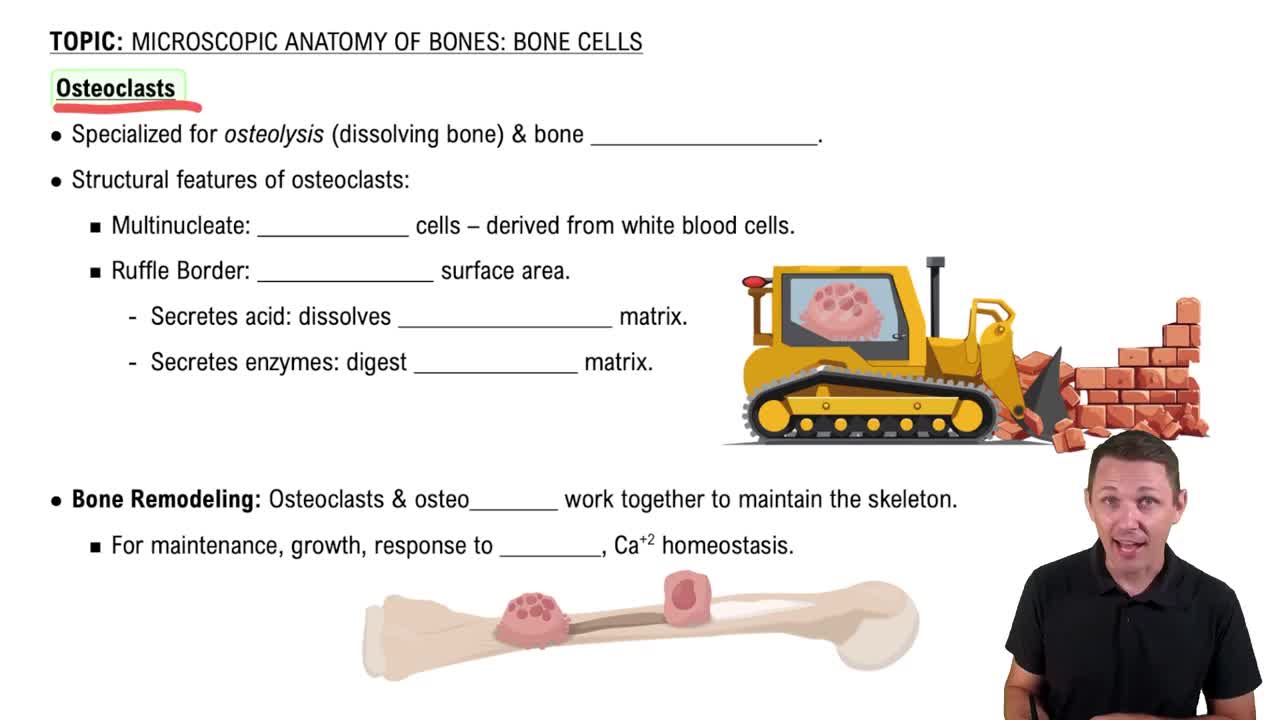
Step 3: Understand the process of bone resorption. Bone resorption is the breakdown of bone tissue, which is carried out by another type of specialized cell called osteoclasts. These cells are responsible for degrading the bone matrix to release stored minerals, such as calcium, back into the bloodstream.
Step 4: Identify the substances secreted by osteoclasts. Osteoclasts secrete hydrogen ions (H⁺) and enzymes, such as proteases, from their ruffled border. The hydrogen ions create an acidic environment that dissolves the mineralized portion of the bone, while the enzymes break down the organic components, such as collagen.
Step 5: Summarize the roles of osteoblasts and osteoclasts. Osteoblasts are responsible for bone deposition by secreting the organic matrix and facilitating mineralization, while osteoclasts are responsible for bone resorption by secreting acids and enzymes to break down the bone matrix.

Verified video answer for a similar problem:

This video solution was recommended by our tutors as helpful for the problem above.
Was this helpful?

Key Concepts

Here are the essential concepts you must grasp in order to answer the question correctly.

Osteoblasts

Osteoblasts are specialized cells responsible for bone formation. They synthesize and secrete the organic components of the extracellular matrix (ECM), primarily collagen, through a process called exocytosis. This activity is crucial for building new bone tissue and facilitating mineralization, which is essential for maintaining bone strength and integrity.
Recommended video:

Extracellular Matrix (ECM)

The extracellular matrix (ECM) is a complex network of proteins and carbohydrates that provides structural and biochemical support to surrounding cells. In bone tissue, the ECM is primarily composed of collagen fibers and mineral deposits, such as hydroxyapatite, which give bones their rigidity and strength. The ECM plays a vital role in bone development, maintenance, and repair.
Recommended video:

Osteoclasts

Osteoclasts are large, multinucleated cells that are responsible for bone resorption, the process of breaking down bone tissue. They secrete acids and enzymes from their ruffled borders, which dissolve the mineral components of the bone and degrade the organic matrix. This activity is essential for bone remodeling, allowing for the maintenance of bone health and the release of minerals into the bloodstream.
Recommended video: