
Ch. 5 The Integumentary System
Amerman - Human Anatomy & Physiology 2nd Edition
Amerman2nd EditionHuman Anatomy & PhysiologyISBN: 9780136873822Not the one you use?Change textbook
Chapter 5, Problem 8

Which of the following statements is false?
a. Thin skin lacks the stratum lucidum, whereas thick skin has all five epidermal layers.
b. Thick skin is located on the palms, the palmar surfaces of the fingers, the soles of the feet, and the plantar surface of the toes, whereas thin skin is located everywhere else.
c. Thick skin has numerous hairs, whereas thin skin lacks hairs.
d. Thin skin has a thin stratum corneum, and the other layers are thinner than what we find in thick skin.

Verified step by step guidance
1
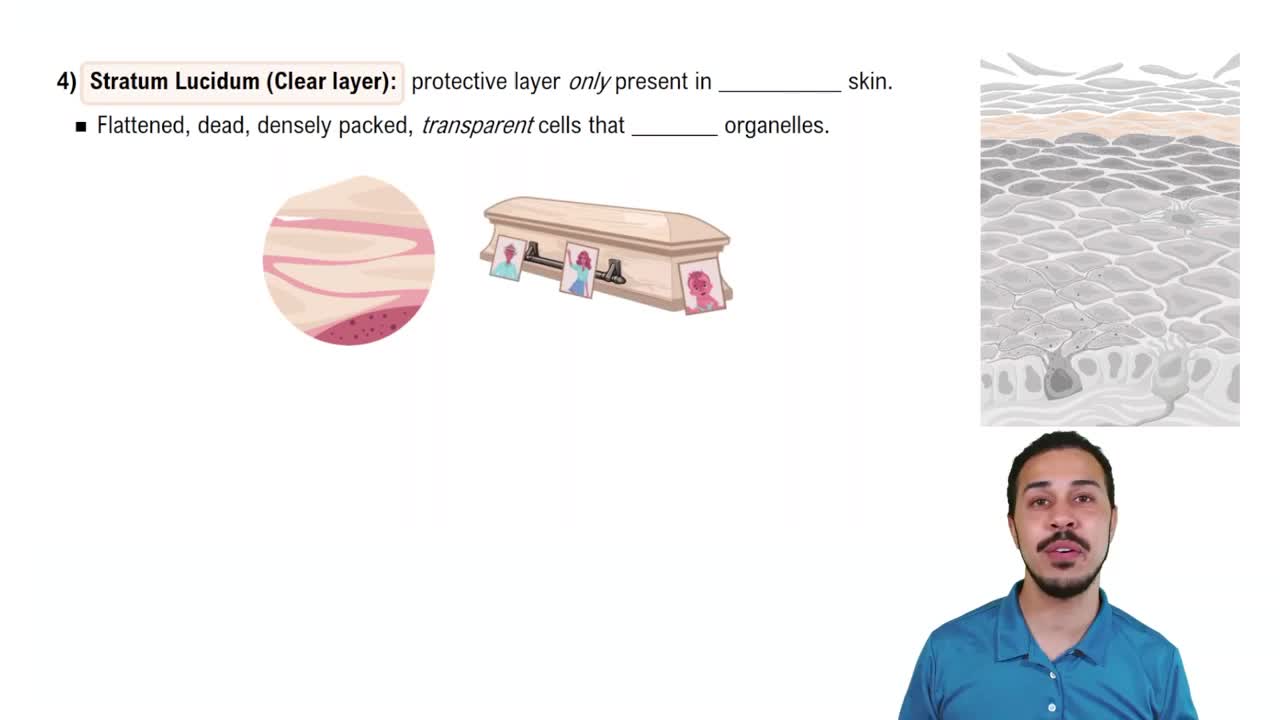
Step 1: Begin by understanding the structure of the epidermis, which consists of five layers: stratum basale, stratum spinosum, stratum granulosum, stratum lucidum, and stratum corneum. Note that the stratum lucidum is only present in thick skin.
Step 2: Review the locations of thick skin and thin skin. Thick skin is found on areas subject to high friction, such as the palms, soles, and corresponding surfaces of fingers and toes. Thin skin covers the rest of the body.
Step 3: Examine the characteristics of thick skin and thin skin. Thick skin lacks hair follicles and sebaceous glands but has a thicker stratum corneum. Thin skin has hair follicles, sebaceous glands, and a thinner stratum corneum.
Step 4: Analyze the statements provided in the problem. Compare each statement to the anatomical and physiological facts about thick and thin skin. Pay special attention to the claim that thick skin has numerous hairs, as this contradicts the known characteristics of thick skin.
Step 5: Identify the false statement based on your analysis. The false statement is the one that incorrectly describes the features of thick or thin skin, specifically the claim that thick skin has numerous hairs.

Verified video answer for a similar problem:

This video solution was recommended by our tutors as helpful for the problem above.
Was this helpful?

Key Concepts

Here are the essential concepts you must grasp in order to answer the question correctly.

Epidermal Layers

The epidermis is the outermost layer of skin, consisting of five distinct layers in thick skin: stratum corneum, stratum lucidum, stratum granulosum, stratum spinosum, and stratum basale. Thin skin, in contrast, lacks the stratum lucidum and has fewer layers overall, making it more flexible and less protective than thick skin.
Recommended video:
02:31
Epidermal Layers: Stratum Lucidum (Clear Layer)

Location of Skin Types

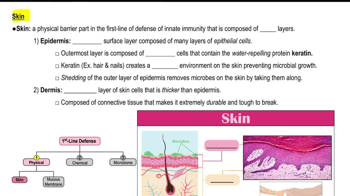
Thick skin is primarily found in areas subject to friction and abrasion, such as the palms of the hands and soles of the feet. Thin skin covers the rest of the body, providing a more flexible and less protective barrier, which is suitable for areas that require more mobility and sensitivity.
Recommended video:
4:08
Skin

Hair Follicles in Skin

Thick skin is characterized by the absence of hair follicles, which is a key distinction from thin skin that contains hair. This absence of hair in thick skin contributes to its protective function, while thin skin's hair follicles allow for sensory functions and thermoregulation.
Recommended video:
4:08
Skin