
Textbook Question
Mark the following statements as true or false. If a statement is false, correct it to make a true statement.
Merkel cells produce the pigment melanin.
2
views

 Verified step by step guidance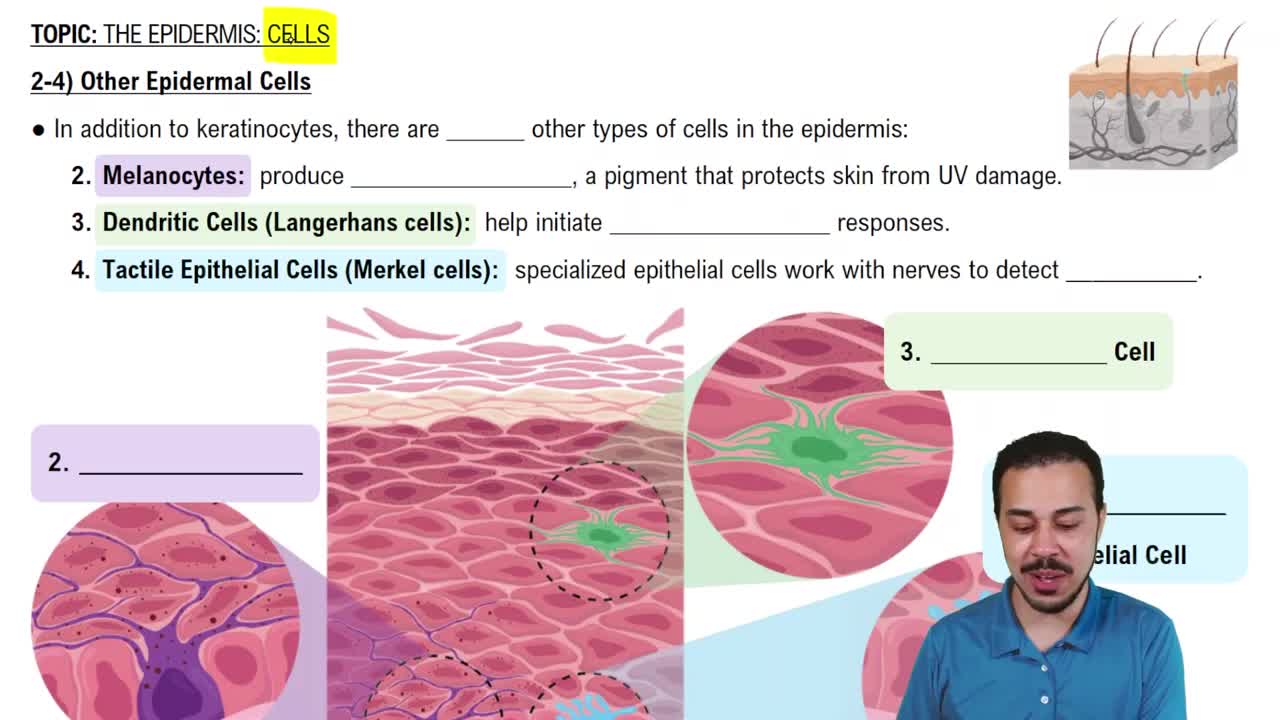
 07:02
07:02
 06:14
06:14 01:20
01:20Mark the following statements as true or false. If a statement is false, correct it to make a true statement.
Merkel cells produce the pigment melanin.
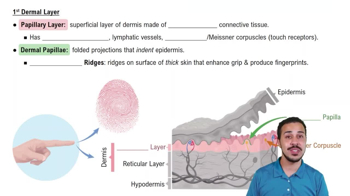
What are the functions of the dermal papillae?
Mark the following statements as true or false. If a statement is false, correct it to make a true statement.
The primary skin pigment is melanin, which is derived from the amino acid tyrosine.
Mark the following statements as true or false. If a statement is false, correct it to make a true statement.
Melanin is produced by melanocytes and covers the nuclei of neighboring dendritic cells.
Mark the following statements as true or false. If a statement is false, correct it to make a true statement.
Carotene is a brown-black pigment that accumulates in the stratum corneum.
Which of the following statements is false?
a. Thin skin lacks the stratum lucidum, whereas thick skin has all five epidermal layers.
b. Thick skin is located on the palms, the palmar surfaces of the fingers, the soles of the feet, and the plantar surface of the toes, whereas thin skin is located everywhere else.
c. Thick skin has numerous hairs, whereas thin skin lacks hairs.
d. Thin skin has a thin stratum corneum, and the other layers are thinner than what we find in thick skin.