

Ch. 24 The Urinary System
Amerman - Human Anatomy & Physiology 2nd Edition
Amerman2nd EditionHuman Anatomy & PhysiologyISBN: 9780136873822Not the one you use?Change textbook
Chapter 24, Problem L3.A1b

Drugs that treat hypertension, or high blood pressure, have the following actions. Discuss the specific effect that each drug will have on the kidneys.
b. Blocking the receptor for angiotensin-II on blood vessels and in the renal tubule cells

Verified step by step guidance
1
Understand the role of angiotensin-II in the body: Angiotensin-II is a hormone that plays a key role in regulating blood pressure and fluid balance. It causes blood vessels to constrict (vasoconstriction) and stimulates the reabsorption of sodium and water in the kidneys, which increases blood volume and pressure.
Identify the effect of blocking angiotensin-II receptors on blood vessels: Blocking these receptors prevents vasoconstriction, leading to the dilation of blood vessels (vasodilation). This reduces peripheral resistance and lowers blood pressure.
Determine the effect of blocking angiotensin-II receptors in renal tubule cells: Angiotensin-II normally stimulates the reabsorption of sodium and water in the renal tubules. Blocking its receptors reduces sodium and water reabsorption, leading to increased excretion of sodium (natriuresis) and water (diuresis), which decreases blood volume and pressure.
Connect the effects on the kidneys to overall blood pressure regulation: By reducing sodium and water reabsorption, the kidneys help lower blood volume, which complements the vasodilation effect to reduce blood pressure effectively.
Summarize the combined impact: Blocking angiotensin-II receptors reduces both vascular resistance and blood volume, making it an effective mechanism for treating hypertension while also reducing the workload on the kidneys.

Verified video answer for a similar problem:

This video solution was recommended by our tutors as helpful for the problem above.
Was this helpful?

Key Concepts

Here are the essential concepts you must grasp in order to answer the question correctly.

Angiotensin II Receptor Blockade

Angiotensin II is a hormone that plays a crucial role in regulating blood pressure and fluid balance. Blocking its receptors, particularly in blood vessels and renal tubule cells, leads to vasodilation and reduced reabsorption of sodium and water, which lowers blood pressure. This mechanism is fundamental in the action of certain antihypertensive drugs, such as angiotensin receptor blockers (ARBs).
Recommended video:
11:30
Renin-Angiotensin-Aldosterone-System

Renal Tubule Function

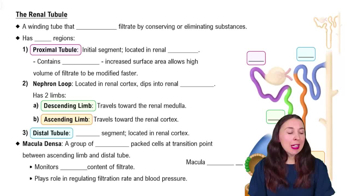
The renal tubules are responsible for the reabsorption of water, sodium, and other substances from the filtrate back into the bloodstream. When angiotensin II receptors in these cells are blocked, the reabsorption process is inhibited, resulting in increased urine output and decreased blood volume, which contributes to lower blood pressure. Understanding this function is essential for comprehending how antihypertensive drugs affect kidney function.
Recommended video:
4:21
The Renal Tubule

Hypertension and Kidney Health

Hypertension can lead to kidney damage over time, as high blood pressure can cause changes in the renal vasculature and impair kidney function. Antihypertensive drugs that target the renin-angiotensin system not only help lower blood pressure but also protect the kidneys from damage. This relationship highlights the importance of managing hypertension to maintain overall kidney health.
Recommended video:
1:00
The Kidneys Example 1
Related Practice
Textbook Question

Mr. Gupta has been diagnosed with nephrotic syndrome, which is characterized by the loss of plasma proteins such as albumin into the urine. What impact will this have on his colloid osmotic pressure? How will this affect the net filtration pressure in his capillary beds? What effect will this likely cause?

2
views
Textbook Question

Explain how each of the drugs in question 1 from this section would lower blood pressure.

1
views
Textbook Question

Deana is a 4-year-old girl with a rare genetic defect that causes the Na+/glucose symporters in the proximal tubule to reabsorb fewer glucose and sodium ions than normal. Predict the effects this defect will have on the composition and volume of Deana's urine. Explain why you would expect to see increased activity of the tubuloglomerular feedback and the renin-angiotensin-aldosterone system in Deana's kidneys.

6
views
Textbook Question

Mr. Wu is a patient with kidney disease who presents to your clinic for monitoring. You notice on his chart that his GFR was estimated through inulin administration to be about 35 ml/min. What does this tell you about the health of his kidneys? Mr. Wu is taking a medication that is normally excreted from the body in the urine. You order blood work and find that the concentration of this medication in his plasma is much higher than normal. How does his decreased GFR explain the elevated level of medication in his plasma?

7
views
Textbook Question

Drugs that treat hypertension, or high blood pressure, have the following actions. Discuss the specific effect that each drug will have on the kidneys.

c. Blocking the Na+/Cl−/2K+ transport pumps in the thick ascending limb of the nephron loop

2
views
Textbook Question

Drugs that treat hypertension, or high blood pressure, have the following actions. Discuss the specific effect that each drug will have on the kidneys.

a. Blocking the action of aldosterone on the kidneys

1
views