
Ch. 22 The Digestive System
Amerman - Human Anatomy & Physiology 2nd Edition
Amerman2nd EditionHuman Anatomy & PhysiologyISBN: 9780136873822Not the one you use?Change textbook
Chapter 22, Problem 15

The primary hormone that triggers the secretion of pancreatic juice and bile is:
a. Gastric inhibitory peptide
b. Cholecystokinin
c. Motilin
d. Somatostatin

Verified step by step guidance
1
Understand the role of pancreatic juice and bile in digestion. Pancreatic juice contains enzymes that help break down carbohydrates, proteins, and fats, while bile aids in the emulsification of fats.
Review the functions of the listed hormones: Gastric inhibitory peptide (GIP) primarily inhibits gastric motility and secretion, cholecystokinin (CCK) stimulates the release of bile and pancreatic enzymes, motilin regulates gastrointestinal motility, and somatostatin inhibits the secretion of various hormones and digestive enzymes.
Focus on the hormone that directly stimulates the secretion of pancreatic juice and bile. Cholecystokinin (CCK) is released in response to the presence of fats and proteins in the small intestine and triggers the gallbladder to release bile and the pancreas to secrete digestive enzymes.
Eliminate the incorrect options based on their primary functions: Gastric inhibitory peptide (a) does not stimulate bile or pancreatic juice secretion, motilin (c) is involved in motility rather than secretion, and somatostatin (d) inhibits secretion rather than stimulating it.
Conclude that the correct answer is the hormone responsible for stimulating both bile and pancreatic juice secretion, which is cholecystokinin (b).

Verified video answer for a similar problem:

This video solution was recommended by our tutors as helpful for the problem above.
Was this helpful?

Key Concepts

Here are the essential concepts you must grasp in order to answer the question correctly.

Cholecystokinin (CCK)

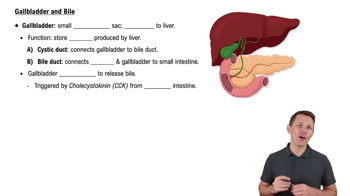
Cholecystokinin is a peptide hormone produced by the cells in the duodenum in response to the presence of fats and proteins. It plays a crucial role in digestion by stimulating the gallbladder to contract and release bile, as well as prompting the pancreas to secrete digestive enzymes. Understanding CCK is essential for recognizing its function in the digestive process.
Recommended video:
Guided course
6:54
Gallbladder and Bile

Pancreatic Juice

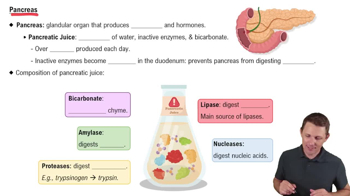
Pancreatic juice is a digestive fluid produced by the pancreas that contains enzymes such as amylase, lipase, and proteases. These enzymes are vital for breaking down carbohydrates, fats, and proteins in the small intestine. The secretion of pancreatic juice is primarily stimulated by hormones like cholecystokinin, making it important to understand its role in digestion.
Recommended video:

Bile

Bile is a digestive fluid produced by the liver and stored in the gallbladder, primarily composed of bile salts, cholesterol, and bilirubin. It is essential for the emulsification and absorption of dietary fats in the small intestine. The release of bile is triggered by hormones such as cholecystokinin, highlighting its importance in the digestive process.
Recommended video:
Guided course
6:54
Gallbladder and Bile
Related Practice
Textbook Question

Which of the following best describes the role of bile salts in lipid digestion?

a. Bile salts begin chemical digestion of lipids.

b. Bile salts bind to lipids and physically break them apart into monoglycerides and free fatty acids.

c. Bile salts bind to lipids and physically break them apart into smaller pieces.

d. Bile salts interact with pancreatic lipase and catalyze lipid breakdown.

4
views
Textbook Question

Lipids associate with bile salts in the small intestine to form_____ . In the enterocyte, lipids are packaged with other lipids into______.

2
views
Textbook Question

Mark the following statements as true or false. If a statement is false, correct it to make a true statement.

c. Smooth muscle of the stomach contracts when food enters from the esophagus.

4
views
Textbook Question

Mark the following statements as true or false. If a statement is false, correct it to make a true statement.

b. The esophageal and pharyngeal phases of swallowing are mediated by the swallowing reflex of the brainstem and the enteric nervous system.

Textbook Question

Which of the following best describes the microscopic structure of the liver?

a. Hexagonal plates of hepatocytes surrounding a central vein with portal triads at each corner

b. Octagonal plates of hepatocytes surrounding a central artery with portal triads at each corner

c. Irregular groups of hepatocytes surrounding a central vein with bile ducts at each corner

d. Hexagonal plates of hepatocytes surrounding a portal vein with bile ducts at each corner

4
views
Textbook Question

Which of the following is/are absorbed in the small intestine by the Na+/glucose cotransporter?

a. Glucose

b. Galactose

c. Fructose

d. Both a and b are correct

e. All of the above are correct

1
views