Ch. 22 The Digestive System
Amerman - Human Anatomy & Physiology 2nd Edition
Amerman2nd EditionHuman Anatomy & PhysiologyISBN: 9780136873822Not the one you use?Change textbook
Chapter 22, Problem 5

The common hepatic duct and main pancreatic duct enter into the:
a. Pyloric sphincter
b. Duodenum
c. Ileum
d. Cecum

Verified step by step guidance
1
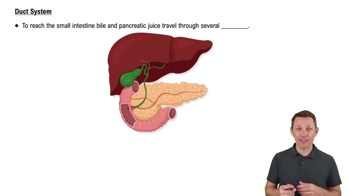
Understand the anatomy of the digestive system and the role of ducts in transporting bile and pancreatic enzymes. The common hepatic duct carries bile from the liver, and the main pancreatic duct carries digestive enzymes from the pancreas.
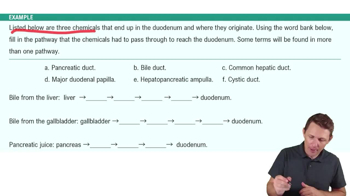
Identify the location where these ducts merge or enter the digestive tract. Both ducts join at the hepatopancreatic ampulla (also known as the ampulla of Vater) before entering the small intestine.
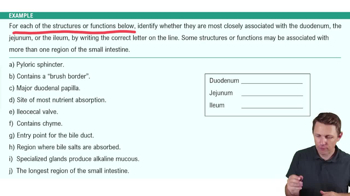
Recall the sections of the small intestine: duodenum, jejunum, and ileum. The duodenum is the first section of the small intestine and is the site where bile and pancreatic enzymes are released to aid digestion.
Eliminate incorrect options based on anatomical knowledge: The pyloric sphincter is part of the stomach, the ileum is the last section of the small intestine, and the cecum is part of the large intestine. None of these are involved in the entry of the common hepatic duct and main pancreatic duct.
Conclude that the correct answer is the duodenum, as it is the anatomical site where the common hepatic duct and main pancreatic duct release their contents into the digestive system.

Verified video answer for a similar problem:

This video solution was recommended by our tutors as helpful for the problem above.
Was this helpful?

Key Concepts

Here are the essential concepts you must grasp in order to answer the question correctly.

Common Hepatic Duct

The common hepatic duct is a vital structure in the biliary system that carries bile from the liver. It merges with the cystic duct from the gallbladder to form the common bile duct, which plays a crucial role in digestion by delivering bile to the small intestine, particularly the duodenum.
Recommended video:

Main Pancreatic Duct

The main pancreatic duct, also known as the duct of Wirsung, transports digestive enzymes produced by the pancreas to the duodenum. This duct is essential for the proper digestion of food, as it allows the release of enzymes that break down carbohydrates, proteins, and fats.
Recommended video:
Guided course
2:59
Duct System of the Liver, Gallbladder, and Pancreas Example 1

Duodenum

The duodenum is the first section of the small intestine, immediately following the stomach. It is a critical site for digestion, where bile and pancreatic juices mix with chyme to facilitate the breakdown of nutrients. The entry point for both the common hepatic duct and the main pancreatic duct is located here, making it a key area for digestive processes.
Recommended video:
Guided course
3:38
Small Intestine Example 4
Related Practice
Textbook Question

Mark the following statements as true or false. If a statement is false, correct it to make a true statement.

The exocrine cells of the pancreas and salivary glands are islet cells.

3
views
Textbook Question

Mark the following statements as true or false. If a statement is false, correct it to make a true statement.

The muscularis externa of most of the alimentary canal consists of inner circular and outer longitudinal layers of smooth muscle.

2
views
Textbook Question

Match the following terms with the correct definition. 

__Chief cells          

__Parietal cells           

__Gastrin           

__Pyloric sphincter         

__Diffuse neuroendocrine (DNES) cells         

__Gastroesophageal sphincter         

__Pepsin         

__Chyme

a. Hormone that stimulates multiple digestive processes

b. Enzyme that begins protein digestion

c. Produce acid and intrinsic factor

d. Liquid produced as a result of stomach churning

e. Produce pepsinogen

f. Cells in gastric glands that produce hormones

g. Controls passage of bolus from esophagus to stomach

h. Controls passage of stomach contents to duodenum

2
views
Textbook Question

Mark the following statements as true or false. If a statement is false, correct it to make a true statement.

The mucosa of the esophagus, pharynx, and oral cavity contains simple squamous epithelium to protect it from abrasion.

1
views
Textbook Question

Trace the pathway that food takes through the entire alimentary canal, from the oral cavity to the anal canal.

3
views
Textbook Question

What are the three folds of the small intestine called? What is their purpose?

2
views