Ch. 22 The Digestive System
Amerman - Human Anatomy & Physiology 2nd Edition
Amerman2nd EditionHuman Anatomy & PhysiologyISBN: 9780136873822Not the one you use?Change textbook
Chapter 22, Problem 4

Match the following terms with the correct definition. 
__Chief cells          
__Parietal cells           
__Gastrin           
__Pyloric sphincter         
__Diffuse neuroendocrine (DNES) cells         
__Gastroesophageal sphincter         
__Pepsin         
__Chyme
a. Hormone that stimulates multiple digestive processes
b. Enzyme that begins protein digestion
c. Produce acid and intrinsic factor
d. Liquid produced as a result of stomach churning
e. Produce pepsinogen
f. Cells in gastric glands that produce hormones
g. Controls passage of bolus from esophagus to stomach
h. Controls passage of stomach contents to duodenum

Verified step by step guidance
1
Step 1: Understand the terms and their definitions. The terms provided are related to the digestive system, and each has a specific role or function. Familiarize yourself with the terms and their general meanings.
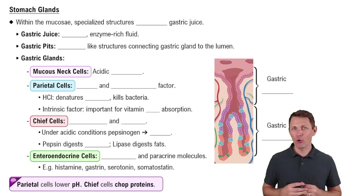
Step 2: Match the term 'Chief cells' with its definition. Chief cells are responsible for producing pepsinogen, an inactive precursor to the enzyme pepsin. Match this with the definition 'e. Produce pepsinogen.'
Step 3: Match the term 'Parietal cells' with its definition. Parietal cells are known for producing hydrochloric acid (HCl) and intrinsic factor, which is essential for vitamin B12 absorption. Match this with the definition 'c. Produce acid and intrinsic factor.'
Step 4: Match the term 'Gastrin' with its definition. Gastrin is a hormone that stimulates various digestive processes, such as acid secretion and gastric motility. Match this with the definition 'a. Hormone that stimulates multiple digestive processes.'
Step 5: Continue matching the remaining terms with their definitions: 'Pyloric sphincter' controls the passage of stomach contents to the duodenum (h), 'Diffuse neuroendocrine (DNES) cells' produce hormones in gastric glands (f), 'Gastroesophageal sphincter' controls the passage of bolus from esophagus to stomach (g), 'Pepsin' is an enzyme that begins protein digestion (b), and 'Chyme' is the liquid produced as a result of stomach churning (d).

Verified video answer for a similar problem:

This video solution was recommended by our tutors as helpful for the problem above.
Was this helpful?

Key Concepts

Here are the essential concepts you must grasp in order to answer the question correctly.

Chief Cells

Chief cells are specialized cells located in the gastric glands of the stomach that primarily produce pepsinogen, an inactive precursor of the enzyme pepsin. When pepsinogen is secreted into the acidic environment of the stomach, it is activated to pepsin, which plays a crucial role in the digestion of proteins.
Recommended video:
05:33
Cell Junctions

Parietal Cells

Parietal cells are another type of cell found in the gastric glands, responsible for secreting hydrochloric acid (HCl) and intrinsic factor. The acid creates an acidic environment necessary for activating digestive enzymes and killing pathogens, while intrinsic factor is essential for vitamin B12 absorption in the intestines.
Recommended video:
05:33
Cell Junctions

Gastrin

Gastrin is a hormone produced by G cells in the stomach lining that stimulates the secretion of gastric acid by parietal cells and promotes gastric motility. It plays a vital role in regulating digestive processes, ensuring that the stomach prepares adequately for food intake and digestion.
Recommended video:
Guided course
7:18
Stomach Glands