Ch. 18 The Cardiovascular System II: The Blood Vessels
Amerman - Human Anatomy & Physiology 2nd Edition
Amerman2nd EditionHuman Anatomy & PhysiologyISBN: 9780136873822Not the one you use?Change textbook
Chapter 18, Problem L2.2

Predict which would be more damaging to long-term survival: a blood clot lodged in the right coronary artery or one in the left coronary artery. Explain.

Verified step by step guidance
1
Understand the role of coronary arteries: The coronary arteries supply oxygenated blood to the heart muscle (myocardium). The right coronary artery primarily supplies blood to the right side of the heart, including the right atrium and right ventricle, while the left coronary artery supplies blood to the left side of the heart, including the left atrium, left ventricle, and parts of the interventricular septum.
Recognize the importance of the left ventricle: The left ventricle is responsible for pumping oxygenated blood to the entire body through the aorta. Any damage to the left ventricle can severely impair systemic circulation and oxygen delivery to tissues, which is critical for survival.
Evaluate the impact of a blood clot in the right coronary artery: A clot in the right coronary artery could lead to ischemia (lack of oxygen) in the right side of the heart. This may impair the heart's ability to pump blood to the lungs for oxygenation, but the systemic circulation would still be supported by the left ventricle.
Evaluate the impact of a blood clot in the left coronary artery: A clot in the left coronary artery could lead to ischemia in the left ventricle, which is the main pumping chamber for systemic circulation. This would significantly reduce the heart's ability to supply oxygenated blood to the body, leading to severe consequences for long-term survival.
Compare the severity of the two scenarios: Since the left coronary artery supplies the left ventricle, which is essential for systemic circulation, a blood clot in the left coronary artery would be more damaging to long-term survival compared to a clot in the right coronary artery. The left ventricle's failure would compromise oxygen delivery to vital organs, including the brain and kidneys.

Verified video answer for a similar problem:

This video solution was recommended by our tutors as helpful for the problem above.
Was this helpful?

Key Concepts

Here are the essential concepts you must grasp in order to answer the question correctly.

Coronary Arteries

The coronary arteries supply blood to the heart muscle itself. The right coronary artery primarily supplies the right side of the heart and parts of the left side, while the left coronary artery branches into the left anterior descending and circumflex arteries, supplying the majority of the left side. Understanding the specific areas each artery serves is crucial for predicting the impact of a blockage.
Recommended video:
14:43
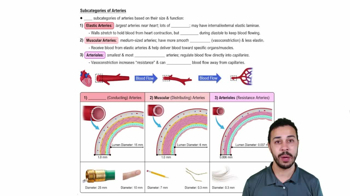
Subcategories of Arteries

Myocardial Ischemia

Myocardial ischemia occurs when blood flow to the heart muscle is reduced, preventing it from receiving enough oxygen. A blockage in a coronary artery can lead to ischemia, which can cause chest pain (angina) and, if prolonged, can result in heart tissue damage or myocardial infarction (heart attack). The severity and location of the blockage determine the extent of ischemia and potential damage.

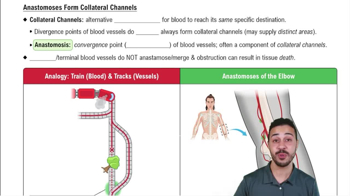
Collateral Circulation

Collateral circulation refers to the network of small blood vessels that can develop to supply blood to areas of the heart when primary arteries are blocked. This adaptive mechanism can mitigate damage from a blockage, particularly if it occurs in a less critical artery. Evaluating the presence and effectiveness of collateral circulation is important when assessing the long-term survival implications of a clot in either coronary artery.
Recommended video:
7:24
Anastomoses Form Collateral Channels