Ch. 18 The Cardiovascular System II: The Blood Vessels
Amerman - Human Anatomy & Physiology 2nd Edition
Amerman2nd EditionHuman Anatomy & PhysiologyISBN: 9780136873822Not the one you use?Change textbook
Chapter 18, Problem 5

Fill in the blanks: The coronary arteries are the first branches off the ________. The right coronary artery becomes the ________ on the posterior side of the heart. The left coronary artery branches into the ________ and the ________.

Verified step by step guidance
1
Step 1: Understand the anatomy of the coronary arteries. The coronary arteries are responsible for supplying oxygenated blood to the heart muscle itself. They originate from the aorta, which is the largest artery in the body.
Step 2: Identify the first blank. The coronary arteries are the first branches off the ascending aorta, which is the initial portion of the aorta as it leaves the heart.
Step 3: Address the second blank. The right coronary artery travels along the right side of the heart and eventually becomes the posterior interventricular artery (also known as the posterior descending artery) on the posterior side of the heart.
Step 4: Focus on the left coronary artery. The left coronary artery branches into two major arteries: the anterior interventricular artery (also known as the left anterior descending artery) and the circumflex artery.
Step 5: Review the anatomical relationships and ensure understanding of how these arteries supply different regions of the heart, including the left and right ventricles, atria, and interventricular septum.

Verified video answer for a similar problem:

This video solution was recommended by our tutors as helpful for the problem above.
Was this helpful?

Key Concepts

Here are the essential concepts you must grasp in order to answer the question correctly.

Coronary Arteries

Coronary arteries are blood vessels that supply oxygen-rich blood to the heart muscle. They branch off from the aorta, which is the main artery that carries blood from the heart to the rest of the body. The two main coronary arteries are the right coronary artery and the left coronary artery, each serving different regions of the heart.
Recommended video:
14:43
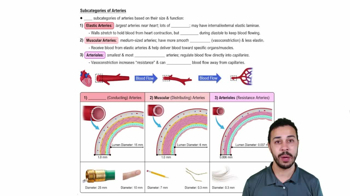
Subcategories of Arteries

Right Coronary Artery

The right coronary artery (RCA) originates from the aorta and primarily supplies blood to the right side of the heart, including the right atrium and right ventricle. It also gives rise to the posterior descending artery, which supplies the inferior part of the heart. Understanding the RCA's role is crucial for comprehending heart function and the implications of coronary artery disease.
Recommended video:
1:42
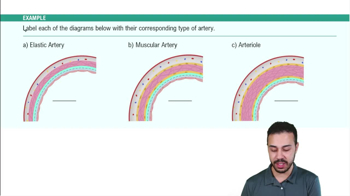
Arteries Example 1

Left Coronary Artery

The left coronary artery (LCA) branches into two main arteries: the left anterior descending artery (LAD) and the circumflex artery. The LAD supplies blood to the front and bottom of the left ventricle and the front of the septum, while the circumflex artery supplies blood to the left atrium and the side and back of the left ventricle. These branches are vital for maintaining the heart's blood supply and overall health.
Recommended video:
1:42
Arteries Example 1
Related Practice
Textbook Question

The lowest pressure in the systemic circuit occurs in the:

a. Arteries

b. Arterioles

c. Capillaries

d. Venules

e. Veins

2
views

Textbook Question

The two pressures within the systemic arterial circuit are the_____ pressure and _____ pressure. The difference between these two pressures is the_____ pressure.

Textbook Question

Which of the following would produce a decrease in blood pressure?

a. Increased cardiac output

b. Vasodilation

c. Vasoconstriction

d. Increased blood volume

8
views
Textbook Question

Which of the following factors would increase peripheral resistance?

a. Increased blood viscosity

b. Shorter vessel

c. Vasodilation

d. An increase in vessel radius

2
views
Textbook Question

Match the following terms with the correct definition.

____ Auricle      

____ Aorta      

____ Coronary sinus       

____ Papillary muscle      

____ Fossa ovalis     

____ Pectinate muscle      

____ Venae cavae      

____ Pulmonary trunk      

____ Chordae tendineae      

____ Pulmonary veins 

a. Drainage point for the coronary veins

b. Extensions that attach papillary muscles to valves

c. Remnant of a hole present in the fetal interatrial septum

d. Two largest veins of the systemic circuit

e. Flaplike extension from the right or left atrium

f. Finger-like projections of ventricular muscle

g. Main artery of the pulmonary circuit

h. Veins that drain the pulmonary circuit

i. Largest artery of the systemic circuit

j. Ridges of muscle in the atria

Textbook Question

Ms. Rodgers has been diagnosed with secretion of inappropriate ADH syndrome (SIADH). What effect will SIADH have on the amount of water in her body? What symptoms would you expect from this condition? How would it affect her blood pressure and net filtration pressure?

1
views