Ch. 12 The Central Nervous System
Amerman - Human Anatomy & Physiology 2nd Edition
Amerman2nd EditionHuman Anatomy & PhysiologyISBN: 9780136873822Not the one you use?Change textbook
Chapter 12, Problem 2b

Mark the following statements about the brain as true or false. If a statement is false, correct it to make a true statement.
The four main components of the brain are the cerebrum, the diencephalon, the cerebellum, and the brainstem.

Verified step by step guidance
1
Step 1: Begin by identifying the four main components of the brain. These are the cerebrum, the diencephalon, the cerebellum, and the brainstem. Confirm whether these components are accurate based on anatomical knowledge.
Step 2: Recall the functions and locations of each component to ensure they are correctly categorized as main components of the brain. For example, the cerebrum is responsible for higher cognitive functions, the diencephalon includes structures like the thalamus and hypothalamus, the cerebellum coordinates movement, and the brainstem controls basic life functions.
Step 3: Evaluate the statement provided in the problem. Compare it to the verified anatomical information about the brain's components.
Step 4: If the statement is true, note that no corrections are needed. If the statement is false, identify the incorrect part and rewrite the statement to make it accurate.
Step 5: Conclude by summarizing the corrected statement (if necessary) and ensure the student understands why the correction was made based on the anatomy of the brain.

Verified video answer for a similar problem:

This video solution was recommended by our tutors as helpful for the problem above.
Was this helpful?

Key Concepts

Here are the essential concepts you must grasp in order to answer the question correctly.

Brain Structure

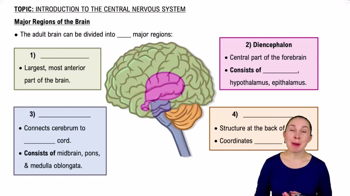
The brain is composed of several key structures, each with distinct functions. The four main components are the cerebrum, responsible for higher cognitive functions; the diencephalon, which includes the thalamus and hypothalamus for sensory and regulatory functions; the cerebellum, which coordinates movement and balance; and the brainstem, which controls basic life functions such as breathing and heart rate.
Recommended video:
Guided course
4:16
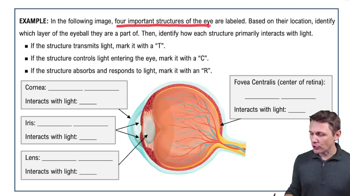
Structure of the Eyeball Example 1

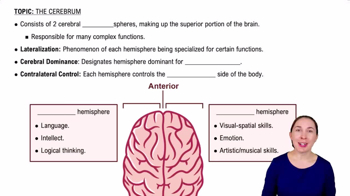
Cerebrum

The cerebrum is the largest part of the brain and is divided into two hemispheres. It is involved in various functions including thought, memory, emotion, and sensory processing. The cerebrum is further divided into lobes: frontal, parietal, temporal, and occipital, each associated with different functions such as decision-making, spatial awareness, and visual processing.
Recommended video:
3:17
The Cerebrum

Diencephalon

The diencephalon is a small but crucial part of the brain located beneath the cerebrum. It consists of structures such as the thalamus, which acts as a relay station for sensory information, and the hypothalamus, which regulates vital functions like temperature, hunger, and the sleep-wake cycle. Understanding the diencephalon's role is essential for grasping how the brain processes and responds to internal and external stimuli.
Recommended video:
3:10
Major Regions of the Brain