Anatomy & Physiology
My Course
Learn
Exam Prep
AI Tutor
Study Guides
Textbook Solutions
Flashcards
Explore
Try the app
My Course
Learn
Exam Prep
AI Tutor
Study Guides
Textbook Solutions
Flashcards
Explore
Try the app
Back
T Dependent & T Independent Antigens quiz
You can tap to flip the card.
What are the two types of antigens involved in B cell activation?
You can tap to flip the card.
👆
What are the two types of antigens involved in B cell activation?
The two types are T dependent antigens and T independent antigens.
Track progress
Control buttons has been changed to "navigation" mode.
1/15
Related flashcards
Recommended videos
T Dependent & T Independent Antigens definitions
T Dependent & T Independent Antigens
15 Terms
3:11
B cell Activation by T Independent Antigens
1
views
5:09
B cell Activation by T Dependent Antigens
2:08
T Dependent & T Independent Antigens
1
views
Terms in this set (15)
Hide definitions
What are the two types of antigens involved in B cell activation?
The two types are T dependent antigens and T independent antigens.
What do T dependent antigens require for B cell activation?
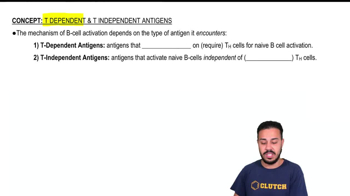
T dependent antigens require helper T cells (TH cells) to activate naive B cells.
How do T independent antigens activate B cells?
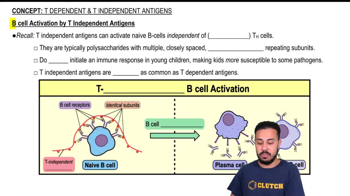
T independent antigens can activate naive B cells without the help of helper T cells.
What is the first step in B cell activation by T dependent antigens?
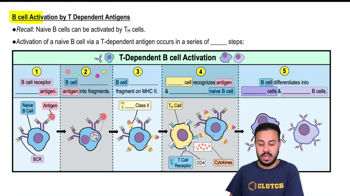
The B cell receptor (BCR) binds to the free antigen.
What happens after the BCR binds the antigen in T dependent activation?
The B cell internalizes and processes the antigen into smaller fragments.
On what molecule are antigen fragments presented during T dependent activation?
Antigen fragments are presented on MHC class II molecules.
Which cell recognizes antigens presented on MHC class II molecules?
Helper T cells (TH cells) recognize antigens presented on MHC class II.
What do helper T cells release to activate B cells?
Helper T cells release cytokines to activate naive B cells.
What are the two cell types that activated B cells can differentiate into?
Activated B cells can become plasma cells or memory B cells.
What is the key feature of T dependent antigens?
They require helper T cells for B cell activation.
What is the typical structure of T independent antigens?
T independent antigens are usually long polysaccharides with closely spaced identical repeating subunits.
Why are young children more susceptible to pathogens with T independent antigens?
T independent antigens usually do not initiate an immune response in very young children.
Are T independent antigens more or less common than T dependent antigens?
T independent antigens are less common than T dependent antigens.
What happens to a naive B cell after activation by T independent antigens?
It can proliferate and differentiate into plasma cells or memory B cells.
What is the main difference between T dependent and T independent antigens in B cell activation?
T dependent antigens require helper T cells, while T independent antigens do not.