Anatomy & Physiology
My Course
Learn
Exam Prep
AI Tutor
Study Guides
Textbook Solutions
Flashcards
Explore
Try the app
My Course
Learn
Exam Prep
AI Tutor
Study Guides
Textbook Solutions
Flashcards
Explore
Try the app
Back
T Dependent & T Independent Antigens definitions
You can tap to flip the card.
B cell activation
You can tap to flip the card.
👆
B cell activation
The process by which B cells become activated to respond to antigens, involving either T dependent or T independent pathways.
Track progress
Control buttons has been changed to "navigation" mode.
1/15
Related flashcards
Recommended videos
T Dependent & T Independent Antigens quiz
T Dependent & T Independent Antigens
15 Terms
3:11
B cell Activation by T Independent Antigens
1
views
5:09
B cell Activation by T Dependent Antigens
2:08
T Dependent & T Independent Antigens
1
views
Terms in this set (15)
Hide definitions
B cell activation
The process by which B cells become activated to respond to antigens, involving either T dependent or T independent pathways.
T dependent antigens
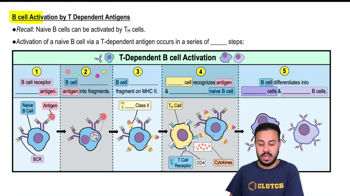
Antigens that require helper T cells for B cell activation, involving a multi-step process including antigen presentation on MHC class II.
T independent antigens
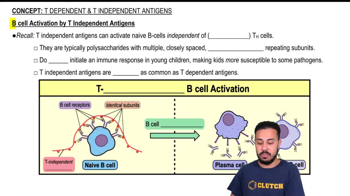
Antigens capable of activating B cells without helper T cells, often long polysaccharides with repeating subunits.
Helper T cells
Immune cells that assist in the activation of B cells by recognizing antigens presented on MHC class II molecules.
Naive B cells
Inactive B cells that have not yet encountered an antigen and require activation to respond to pathogens.
B cell receptors (BCRs)
Molecules on B cell surfaces that bind to specific antigens, initiating the activation process.
MHC class II molecules
Proteins on B cell surfaces that present processed antigen fragments to helper T cells for recognition.
Cytokines
Signaling molecules released by helper T cells to activate B cells during immune responses.
Plasma cells
Differentiated B cells that secrete antibodies to neutralize pathogens.
Memory B cells
B cells that remain after an infection to provide a faster response upon re-exposure to the same antigen.
Polysaccharides
Long carbohydrate molecules with repeating subunits, often forming T independent antigens.
Immune response
The body's defense mechanism against pathogens, involving B cell activation and antibody production.
Pathogens
Microorganisms that cause disease, targeted by the immune system through B cell activation.
Antibodies
Proteins produced by plasma cells that bind to antigens to neutralize or mark them for destruction.
T cell receptors (TCRs)
Molecules on T cells that recognize antigens presented by MHC class II molecules on B cells.