Skip to main content
Anatomy & Physiology
My Course
Learn
Exam Prep
AI Tutor
Study Guides
Textbook Solutions
Flashcards
Explore
Try the app
My Course
Learn
Exam Prep
AI Tutor
Study Guides
Textbook Solutions
Flashcards
Explore
Try the app
Back
Electrical Conduction System of the Heart definitions
You can tap to flip the card.
Sinoatrial Node
You can tap to flip the card.
👆
Sinoatrial Node
Primary pacemaker of the heart, located in the right atrium, initiating action potentials for heartbeats.
Track progress
Control buttons has been changed to "navigation" mode.
1/15
Related flashcards
Related practice
Recommended videos
Electrical Conduction System of the Heart quiz #1
Electrical Conduction System of the Heart
39 Terms
Electrical Conduction System of the Heart quiz #2
Electrical Conduction System of the Heart
31 Terms
Electrical Conduction System of the Heart quiz #3
Electrical Conduction System of the Heart
25 Terms
Electrical Conduction System of the Heart
18. The Heart
6 problems
Topic
Jason
Cardiac Action Potentials
18. The Heart
7 problems
Topic
Jason
18. The Heart
4 topics
11 problems
Chapter
Jason
6:13
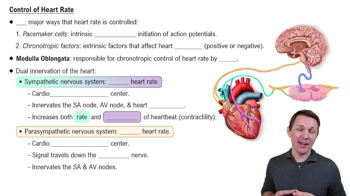
Control of Heart Rate
4
views
8:41
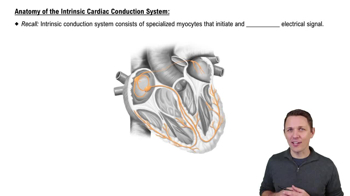
Anatomy of the Intrinsic Cardiac Conduction System
4
views
3:42
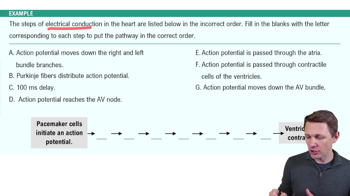
Electrical Conduction System of the Heart Example 2
3
views
Terms in this set (15)
Hide definitions
Sinoatrial Node
Primary pacemaker of the heart, located in the right atrium, initiating action potentials for heartbeats.
Atrioventricular Node
Located in the right atrial wall, it delays action potentials to ensure atria contract before ventricles.
Bundle of His
Conducting fibers in the heart's septum, transmitting impulses from the AV node to the ventricles.
Purkinje Fibers
Network of fibers spreading impulses through ventricles, ensuring coordinated contraction.
Pacemaker Cells
Specialized cardiac cells that depolarize at regular intervals, initiating heartbeats.
Gap Junctions
Connections between cardiac cells allowing rapid spread of action potentials for synchronized contraction.
Chronotropic Factors
External influences that modify heart rate, such as sympathetic and parasympathetic nervous system inputs.
Sympathetic Nervous System
Part of the autonomic nervous system that increases heart rate and contractility during stress.
Parasympathetic Nervous System
Part of the autonomic nervous system that decreases heart rate, promoting rest and digestion.
Internodal Pathways
Pathways connecting the SA node to the AV node, facilitating rapid signal transmission across atria.
Atrial Conduction
Process of transmitting action potentials across atria, leading to their contraction.
Ventricular Contraction
Contraction of ventricles following atrial contraction, pushing blood into arteries.
Cardioacceleratory Center
Region in the medulla oblongata that increases heart rate via sympathetic stimulation.
Cardioinhibitory Center
Region in the medulla oblongata that decreases heart rate via parasympathetic stimulation.
Contractility
The strength of heart muscle contraction, influenced by sympathetic nervous system activity.
 BackBack
 6:13
6:13