2. Cell Chemistry & Cell Components
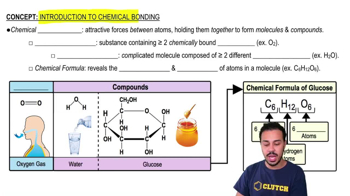
Introduction to Chemical Bonding
2. Cell Chemistry & Cell Components
Introduction to Chemical Bonding
 06:53
06:53

Additional 3 creators.
Learn with other creators






Showing 6 of 6 videos
Practice this topic
- Open Question
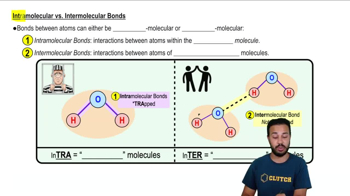
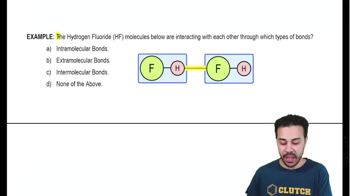
Appropriately label all of the chemical bonds in this image as either intramolecular or intermolecular.
163views - Multiple Choice
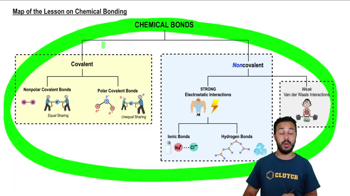
Map of the Lesson on Chemical Bonding
According to the map above, which of the following are types of covalent bonds?
25views - Multiple ChoiceHow would you respond to this reasoning? Oxygen is not a greenhouse gas; therefore, gases containing oxygen—such as ozone, nitrous oxide, and carbon dioxide—are not greenhouse gases either.8views
- Multiple ChoiceAn atom that normally has __________ in its outer shell would not tend to form chemical bonds with other atoms.11views
- Multiple ChoiceThe chemical characteristics or reactivity of an element depend mostly on the __________.5views