Ch. 24 The Urinary System
Amerman - Human Anatomy & Physiology 2nd Edition
Amerman2nd EditionHuman Anatomy & PhysiologyISBN: 9780136873822Not the one you use?Change textbook
Chapter 24, Problem 8

Fill in the blanks for the following statements:
a. When the GFR decreases, the macula densa releases chemicals to______ the afferent arteriole.
b. The sympathetic nervous system______ the blood vessels supplying the kidney _____ to the glomerular filtration rate.
c. The enzyme _____ is released by JG cells in response to a decrease in the GFR.
d. The enzyme ______ converts angiotensin-I to angiotensin-II.
e. Generally, angiotensin-II______ systemic blood pressure while _____ the GFR.

Verified step by step guidance
1
Step 1: Understand the role of the macula densa in regulating the glomerular filtration rate (GFR). When the GFR decreases, the macula densa detects reduced sodium and chloride levels in the filtrate. It responds by releasing chemicals that dilate the afferent arteriole to increase blood flow into the glomerulus, thereby increasing GFR.
Step 2: Recognize the effect of the sympathetic nervous system on kidney function. During stress or low blood pressure, the sympathetic nervous system constricts the blood vessels supplying the kidney, reducing renal blood flow and decreasing the GFR to conserve water and maintain blood pressure.
Step 3: Identify the enzyme released by juxtaglomerular (JG) cells in response to a decrease in GFR. The JG cells release renin, which plays a key role in the renin-angiotensin-aldosterone system (RAAS) to restore blood pressure and GFR.
Step 4: Recall the enzyme responsible for converting angiotensin-I to angiotensin-II. This enzyme is angiotensin-converting enzyme (ACE), which is primarily found in the lungs and catalyzes this conversion.
Step 5: Understand the effects of angiotensin-II. Angiotensin-II increases systemic blood pressure by causing vasoconstriction and stimulating aldosterone release. However, it can also constrict the efferent arteriole of the glomerulus, which helps maintain or slightly increase the GFR despite systemic vasoconstriction.

Verified video answer for a similar problem:

This video solution was recommended by our tutors as helpful for the problem above.
Was this helpful?

Key Concepts

Here are the essential concepts you must grasp in order to answer the question correctly.

Glomerular Filtration Rate (GFR)

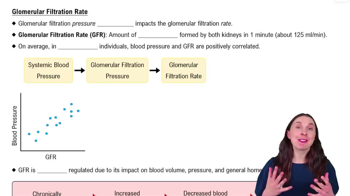
GFR is a measure of how well the kidneys filter blood, specifically the volume of fluid filtered from the renal glomeruli into the Bowman's capsule per unit time. A decrease in GFR can indicate kidney dysfunction and triggers compensatory mechanisms to maintain homeostasis, such as the release of signaling molecules by the macula densa.
Recommended video:
3:15
Glomerular Filtration Rate

Renin-Angiotensin-Aldosterone System (RAAS)

The RAAS is a hormone system that regulates blood pressure and fluid balance. When GFR decreases, juxtaglomerular (JG) cells release renin, which converts angiotensinogen to angiotensin-I. Angiotensin-I is then converted to angiotensin-II by the enzyme angiotensin-converting enzyme (ACE), leading to vasoconstriction and increased blood pressure.
Recommended video:
11:30
Renin-Angiotensin-Aldosterone-System

Sympathetic Nervous System (SNS) Regulation

The sympathetic nervous system plays a crucial role in regulating blood flow to the kidneys, particularly during stress or low blood pressure situations. Activation of the SNS causes vasoconstriction of renal blood vessels, which can reduce blood flow to the kidneys and subsequently affect the GFR, ensuring that vital organs receive adequate blood supply.
Recommended video:
1:21
Sympathetic Nervous System Example 3