Ch. 24 The Urinary System
Amerman - Human Anatomy & Physiology 2nd Edition
Amerman2nd EditionHuman Anatomy & PhysiologyISBN: 9780136873822Not the one you use?Change textbook
Chapter 24, Problem 9

Which of the following is false about the GFR?
a. The GFR averages about 120 ml/min
b. The GFR increases when the afferent arteriole dilates
c. The GFR decreases when the efferent arteriole constricts
d. The GFR decreases when the afferent arteriole constricts

Verified step by step guidance
1
Understand the concept of GFR (Glomerular Filtration Rate): GFR is the rate at which the kidneys filter blood through the glomeruli, typically measured in milliliters per minute (ml/min). It is influenced by factors such as blood pressure and the diameter of the afferent and efferent arterioles.
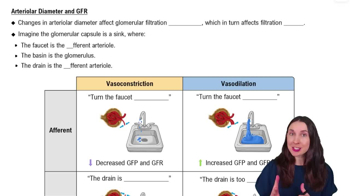
Review the role of the afferent arteriole: The afferent arteriole brings blood into the glomerulus. When it dilates, more blood flows into the glomerulus, increasing the GFR. Conversely, when it constricts, less blood enters the glomerulus, decreasing the GFR.
Review the role of the efferent arteriole: The efferent arteriole carries blood away from the glomerulus. When it constricts, it increases the pressure within the glomerulus, which can increase the GFR. If it dilates, the pressure decreases, lowering the GFR.
Analyze each option: a) The GFR averages about 120 ml/min is true for a healthy adult. b) The GFR increases when the afferent arteriole dilates is true because more blood enters the glomerulus. c) The GFR decreases when the efferent arteriole constricts is false because constriction of the efferent arteriole increases glomerular pressure and GFR. d) The GFR decreases when the afferent arteriole constricts is true because less blood enters the glomerulus.
Conclude that the false statement is option c, as the GFR does not decrease when the efferent arteriole constricts; instead, it increases due to higher glomerular pressure.

Verified video answer for a similar problem:

This video solution was recommended by our tutors as helpful for the problem above.
Was this helpful?

Key Concepts

Here are the essential concepts you must grasp in order to answer the question correctly.

Glomerular Filtration Rate (GFR)

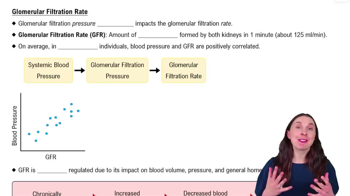
GFR is a measure of how much blood is filtered by the glomeruli in the kidneys per minute, typically averaging around 120 ml/min in healthy adults. It is a crucial indicator of kidney function, reflecting the kidneys' ability to filter waste and excess substances from the blood.
Recommended video:
3:15
Glomerular Filtration Rate

Afferent and Efferent Arterioles

The afferent arteriole supplies blood to the glomerulus, while the efferent arteriole carries blood away. Dilation of the afferent arteriole increases blood flow into the glomerulus, potentially increasing GFR, whereas constriction of the efferent arteriole can increase pressure in the glomerulus, also affecting GFR.
Recommended video:
4:33
Arteriolar Diameter and GFR

Regulation of GFR

GFR is regulated by various factors, including blood pressure and the diameter of the afferent and efferent arterioles. Constriction of the afferent arteriole reduces blood flow into the glomerulus, leading to a decrease in GFR, while constriction of the efferent arteriole can increase GFR by maintaining glomerular pressure.
Recommended video:
4:33
Arteriolar Diameter and GFR
Related Practice
Textbook Question

Mark the following statements as true or false. If a statement is false, correct it to make a true statement.

d. ADH triggers water reabsorption from the nephron loop.

1
views

Textbook Question

Glomerular hydrostatic pressure _____ filtration; colloid osmotic pressure and capsular hydrostatic pressure_____ filtration.

a. Favors; favor

b. Opposes; oppose

c. Favors; oppose

d. Opposes; favor

Textbook Question

Dilute urine is produced when decreased levels of______ are secreted.

a. Aldosterone

b. Atrial natriuretic peptide

c. ADH

d. None of the above

2
views
Textbook Question

Mark the following statements as true or false. If a statement is false, correct it to make a true statement.

e. Obligatory water reabsorption occurs in the distal tubule and collecting system.

Textbook Question

The route by which substances are reabsorbed by crossing through the cells of the renal tubule and collecting system is known as the:

a. Paracellular route

b. Transcellular route

c. Primary active transport route

d. Facultative route

Textbook Question

Fill in the blanks for the following statements:

a. When the GFR decreases, the macula densa releases chemicals to______ the afferent arteriole.

b. The sympathetic nervous system______ the blood vessels supplying the kidney _____ to the glomerular filtration rate.

c. The enzyme _____ is released by JG cells in response to a decrease in the GFR.

d. The enzyme ______ converts angiotensin-I to angiotensin-II.

e. Generally, angiotensin-II______ systemic blood pressure while _____ the GFR.

2
views