
Each of the following statements about protein synthesis is false. Correct each to make a true statement. During translation, amino acids are delivered by the messenger RNA transcript.
Verified step by step guidance
1
Understand the process of translation: Translation is the process by which the genetic code carried by messenger RNA (mRNA) is used to assemble amino acids into a polypeptide chain. This occurs in the ribosome.
Identify the role of mRNA: mRNA serves as the template that provides the sequence of codons, which are groups of three nucleotides that specify particular amino acids.
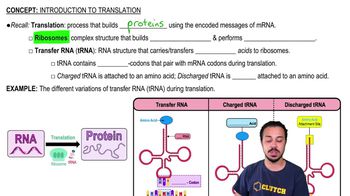
Clarify the role of transfer RNA (tRNA): During translation, amino acids are delivered to the ribosome by transfer RNA (tRNA), not mRNA. Each tRNA molecule has an anticodon that pairs with the corresponding codon on the mRNA and carries the specific amino acid.
Correct the false statement: The corrected statement should read: 'During translation, amino acids are delivered by transfer RNA (tRNA), which pairs with the codons on the messenger RNA transcript.'
Review the overall process: Translation involves three main stages—initiation, elongation, and termination—where tRNA plays a critical role in delivering amino acids to the growing polypeptide chain based on the mRNA sequence.
Verified video answer for a similar problem:
This video solution was recommended by our tutors as helpful for the problem above
Play a video:
0 Comments
Key Concepts
Here are the essential concepts you must grasp in order to answer the question correctly.
Protein Synthesis
Protein synthesis is the biological process through which cells generate new proteins. It involves two main stages: transcription, where DNA is converted into messenger RNA (mRNA), and translation, where the mRNA is used as a template to assemble amino acids into a polypeptide chain, ultimately forming a protein.
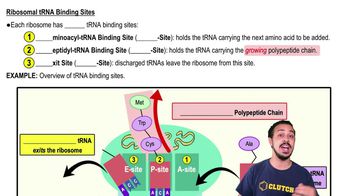
Translation is the second stage of protein synthesis, occurring in the ribosome. During this process, the sequence of nucleotides in mRNA is read in sets of three (codons), and transfer RNA (tRNA) molecules bring the corresponding amino acids to the ribosome, where they are linked together to form a protein.
Transfer RNA (tRNA) plays a crucial role in translation by carrying specific amino acids to the ribosome. Each tRNA molecule has an anticodon that pairs with a corresponding codon on the mRNA, ensuring that the correct amino acid is added to the growing polypeptide chain, thus facilitating accurate protein synthesis.