Which of the following inserts on the arm? a. Biceps brachii b. Triceps brachii c. Trapezius d. Latissimus dorsi
Verified step by step guidance
1
Step 1: Understand the question by identifying the muscles listed and their insertion points. The question asks which muscles insert on the arm, specifically the humerus or other arm-related structures.
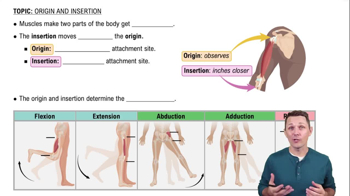
Step 2: Recall the anatomy of the biceps brachii. The biceps brachii inserts on the radial tuberosity of the radius, not directly on the arm (humerus). Therefore, it does not qualify as inserting on the arm.
Step 3: Recall the anatomy of the triceps brachii. The triceps brachii inserts on the olecranon process of the ulna, which is part of the forearm, not the arm (humerus). Thus, it does not insert on the arm either.
Step 4: Recall the anatomy of the trapezius. The trapezius inserts on the clavicle, acromion, and spine of the scapula, which are part of the shoulder girdle, not the arm. Therefore, it does not insert on the arm.
Step 5: Recall the anatomy of the latissimus dorsi. The latissimus dorsi inserts on the intertubercular sulcus of the humerus, which is part of the arm. Therefore, it qualifies as inserting on the arm.
Verified video answer for a similar problem:
This video solution was recommended by our tutors as helpful for the problem above
Video duration:
2m
Play a video:
0 Comments
Key Concepts
Here are the essential concepts you must grasp in order to answer the question correctly.
Muscle Anatomy
Muscle anatomy refers to the structure and function of muscles in the body. Understanding the major muscles of the arm, such as the biceps brachii and triceps brachii, is essential for identifying their roles in movement and their points of insertion on the skeletal system.
Introduction to Muscles and Muscle Tissue Example 1
Muscle Insertion Points
Muscle insertion points are the locations where muscles attach to bones, allowing for movement when the muscle contracts. For example, the biceps brachii inserts on the radius bone of the forearm, enabling flexion at the elbow joint.
Functional movement refers to the actions performed by muscles during physical activity. Recognizing how different muscles contribute to arm movements, such as lifting or pushing, helps in understanding their functional significance and relevance in the context of the question.

 2:02 minutes
 Verified step by step guidance
 2:00
2:00