What are the two types of secondary structures found in polypeptides, and what maintains them? What stabilizes the tertiary structure of a polypeptide?
Verified step by step guidance
1
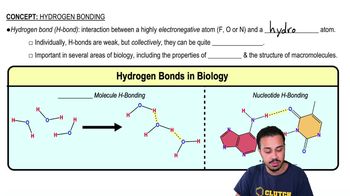
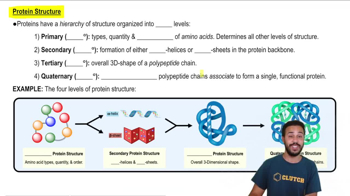
Identify the two types of secondary structures in polypeptides: These are alpha helices and beta pleated sheets. Both structures are common forms of protein folding.
Understand what maintains these structures: The stability of alpha helices and beta pleated sheets is primarily maintained by hydrogen bonds between the carbonyl oxygen of one amino acid and the amide hydrogen of another.
Explore the tertiary structure of polypeptides: Tertiary structure refers to the overall three-dimensional shape of a polypeptide and involves more complex folding patterns of the protein chain.
Recognize what stabilizes the tertiary structure: The stability of the tertiary structure is maintained by various interactions including hydrogen bonds, ionic bonds, disulfide bridges, and hydrophobic interactions.
Consider the role of the environment: Environmental factors such as pH and temperature can affect the stability of both secondary and tertiary structures, influencing the overall conformation and function of the protein.
Verified video answer for a similar problem:
This video solution was recommended by our tutors as helpful for the problem above
Video duration:
54s
Play a video:
0 Comments
Key Concepts
Here are the essential concepts you must grasp in order to answer the question correctly.
Secondary Structure of Proteins
Secondary structures in polypeptides refer to the local folded structures that form within a protein due to hydrogen bonding between the backbone atoms. The two primary types are alpha helices, which are coiled structures, and beta sheets, which are formed by parallel or antiparallel strands. These structures are crucial for the overall shape and function of proteins.
Hydrogen bonds are weak interactions that occur between a hydrogen atom covalently bonded to an electronegative atom and another electronegative atom. In the context of protein secondary structures, these bonds stabilize the alpha helices and beta sheets by forming between the carbonyl oxygen of one amino acid and the amide hydrogen of another, thus maintaining the protein's shape.
The tertiary structure of a polypeptide refers to its overall three-dimensional shape, which is determined by the interactions among various side chains (R groups) of the amino acids. This structure is stabilized by several types of interactions, including hydrogen bonds, ionic bonds, hydrophobic interactions, and disulfide bridges, which collectively contribute to the protein's stability and functionality.