Ch. 2 The Chemistry of Life
Amerman - Human Anatomy & Physiology 2nd Edition
Amerman2nd EditionHuman Anatomy & PhysiologyISBN: 9780136873822Not the one you use?Change textbook
Chapter 2, Problem 10

An enzyme is a:
a. biological catalyst that increases the concentration of the products.
b. biological catalyst that increases the concentration of the reactants.
c. chemical that is used in a reaction, after which it can no longer be used by the cell.
d. biological catalyst that works by bringing its substrates closer to their transition states.

Verified step by step guidance
1
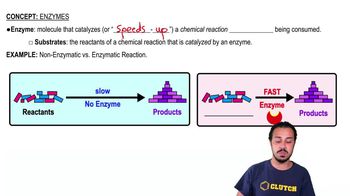
Understand the definition of an enzyme: An enzyme is a biological catalyst, meaning it speeds up chemical reactions in the body without being consumed in the process.
Review the role of a catalyst: Catalysts work by lowering the activation energy required for a reaction to occur, making it easier for reactants to reach their transition state and form products.
Analyze the options provided: Option (a) suggests enzymes increase product concentration, which is incorrect because enzymes do not alter the equilibrium of a reaction. Option (b) suggests enzymes increase reactant concentration, which is also incorrect for the same reason. Option (c) states enzymes are used up in reactions, which contradicts their role as reusable catalysts.
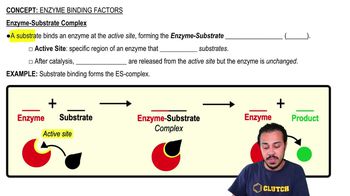
Focus on option (d): This option states that enzymes work by bringing substrates closer to their transition states, which aligns with the mechanism of action of enzymes. Enzymes bind to substrates at their active sites, stabilizing the transition state and facilitating the reaction.
Conclude that the correct answer is the option that accurately describes the function of enzymes as biological catalysts that assist substrates in reaching their transition states without being consumed in the reaction.

Verified video answer for a similar problem:

This video solution was recommended by our tutors as helpful for the problem above.
Was this helpful?

Key Concepts

Here are the essential concepts you must grasp in order to answer the question correctly.

Enzymes as Biological Catalysts

Enzymes are proteins that act as biological catalysts, meaning they accelerate chemical reactions without being consumed in the process. They lower the activation energy required for reactions, allowing them to occur more quickly and efficiently. This catalytic function is crucial for various biological processes, including metabolism and DNA replication.
Recommended video:
02:55
Enzymes

Substrate and Active Site Interaction

The active site of an enzyme is a specific region where substrates bind. This interaction is highly specific, often described by the 'lock and key' model, where the enzyme's active site (the 'lock') is shaped to fit a particular substrate (the 'key'). This proximity facilitates the transition state, leading to the formation of products more efficiently.
Recommended video:
03:49
Enzyme-Substrate Complex

Transition State Theory

Transition state theory posits that during a chemical reaction, reactants must reach a high-energy state known as the transition state before converting into products. Enzymes stabilize this transition state, effectively lowering the energy barrier and increasing the likelihood of the reaction proceeding. This concept is fundamental to understanding how enzymes enhance reaction rates.
Recommended video:
07:29
Endosymbiotic Theory
Related Practice
Textbook Question

Which of the following is not a property of water?

a. Water has a high heat capacity.

b. Water doesn't take heat with it when it evaporates.

c. Water is a polar solvent in which many solutes will dissolve.

d. Water serves as a cushion and lubricant in the body.

1
views
Textbook Question

With respect to their solubility in water, substances with nonpolar covalent bonds are__________, while substances with polar covalent and ionic bonds are__________.

3
views
Textbook Question

Mark the following statements as true or false. If a statement is false, correct it to make a true statement.

Acids dissociate in water to give hydrogen ions and an anion.

1
views
Textbook Question

Which of the following would not result in an increase in reaction rate?

a. Increase in temperature

b. Particles in the solid phase

c. Presence of a catalyst

d. Smaller particle size

1
views
Textbook Question

Describe what takes place during a chemical reaction.

1
views
Textbook Question

Match the following terms with the correct definition:

      Endergonic reaction

      Potential energy

      Electrical energy

      Anabolic reaction

      Oxidation-reduction reaction

      Chemical energy

      Catabolic reaction

      Kinetic energy

a. Energy in motion

b. Energy stored in chemical bonds

c. Reaction that consumes energy

d. A decomposition reaction

e. The energy of moving charged particles

f. Stored energy

g. Synthesis reaction

h. Reaction where electrons are transferred between reactants  

4
views