Ch. 17 The Special Senses
Martini - Fundamentals of Anatomy & Physiology 11th Edition
Martini, Nath, Bartholomew11th EditionFundamentals of Anatomy & PhysiologyISBN: 9780136874089Not the one you use?Change textbook
Chapter 17, Problem 24

You are at a park watching some deer 35 feet away from you. A friend taps you on the shoulder to ask a question. As you turn to look at your friend, who is standing just 2 feet away, what changes would your eyes undergo?

Verified step by step guidance
1
Understand that when you shift your gaze from a distant object (the deer 35 feet away) to a nearby object (your friend 2 feet away), your eyes must adjust to focus clearly on the new distance. This process is called accommodation.
Accommodation involves the ciliary muscles in the eye contracting to change the shape of the lens. Specifically, the lens becomes thicker and more curved to increase its refractive power, allowing light rays from the closer object to focus properly on the retina.
In addition to accommodation, your eyes will also undergo convergence, where both eyeballs rotate inward toward the nose to align the image of the close object on corresponding points of both retinas, enabling single binocular vision.
Pupil constriction often accompanies accommodation and convergence to increase the depth of field and improve focus on the near object by reducing the amount of light entering the eye.
Summarize that these changes—lens thickening (accommodation), eye rotation inward (convergence), and pupil constriction—work together to help your eyes shift focus from the distant deer to your nearby friend.

Verified video answer for a similar problem:

This video solution was recommended by our tutors as helpful for the problem above.
Was this helpful?

Key Concepts

Here are the essential concepts you must grasp in order to answer the question correctly.

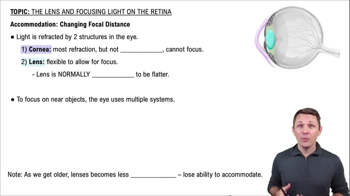
Accommodation of the Eye

Accommodation is the process by which the eye's lens changes shape to focus on objects at different distances. When looking at a nearby object, the ciliary muscles contract, making the lens thicker to increase its refractive power. Conversely, for distant objects, the lens flattens. This adjustment ensures a clear image is formed on the retina.
Recommended video:
Guided course
5:58
Accommodation: Changing Focal Distance

Pupil Constriction and Dilation

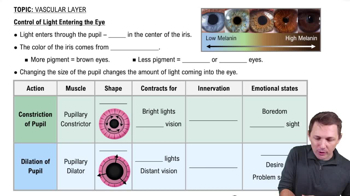
The pupil controls the amount of light entering the eye and adjusts based on focus distance. When focusing on near objects, the pupil constricts to increase the depth of field and reduce spherical aberrations. For distant objects, the pupil dilates to allow more light in, aiding vision under lower light conditions.
Recommended video:
Guided course
8:07
Control of Light Entering the Eye

Convergence of the Eyes

Convergence is the inward movement of both eyes toward each other to maintain single binocular vision when viewing close objects. As the friend is only 2 feet away, your eyes will converge more compared to when looking at the deer 35 feet away. This helps align the images on the retinas for proper depth perception.
Recommended video:
Guided course
8:07
Control of Light Entering the Eye