
Ch. 14 The Brain and Cranial Nerves
Martini - Fundamentals of Anatomy & Physiology 11th Edition
Martini, Nath, Bartholomew11th EditionFundamentals of Anatomy & PhysiologyISBN: 9780136874089Not the one you use?Change textbook
Chapter 14, Problem 27

What kinds of problems are associated with the presence of lesions in the Wernicke's area and the Broca's area?

Verified step by step guidance
1
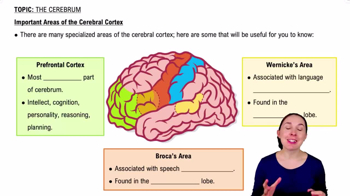
Step 1: Understand the location and function of Wernicke's area. Wernicke's area is located in the posterior part of the superior temporal gyrus in the dominant cerebral hemisphere (usually the left hemisphere) and is primarily responsible for language comprehension.
Step 2: Recognize the effects of lesions in Wernicke's area. Damage here typically results in Wernicke's aphasia, characterized by impaired language comprehension and fluent but nonsensical speech, often with difficulty understanding spoken and written language.
Step 3: Understand the location and function of Broca's area. Broca's area is located in the posterior part of the inferior frontal gyrus of the dominant hemisphere and is mainly involved in speech production and language expression.
Step 4: Recognize the effects of lesions in Broca's area. Damage to this area leads to Broca's aphasia, which is characterized by non-fluent, effortful speech with relatively preserved comprehension, causing difficulty in forming complete sentences and articulating words.
Step 5: Summarize the differences between the two aphasias. Lesions in Wernicke's area affect language comprehension and produce fluent but meaningless speech, while lesions in Broca's area affect speech production, resulting in slow, labored speech with good comprehension.

Verified video answer for a similar problem:

This video solution was recommended by our tutors as helpful for the problem above.
Video duration:
3m
Was this helpful?

Key Concepts

Here are the essential concepts you must grasp in order to answer the question correctly.

Wernicke's Area and Language Comprehension

Wernicke's area, located in the posterior part of the temporal lobe, is crucial for language comprehension. Lesions here typically cause Wernicke's aphasia, characterized by fluent but nonsensical speech and difficulty understanding spoken or written language.
Recommended video:
3:15
Important Areas of the Cerebral Cortex

Broca's Area and Language Production

Broca's area, found in the frontal lobe, is essential for speech production and language expression. Damage to this area results in Broca's aphasia, marked by slow, effortful speech and difficulty forming complete sentences, while comprehension often remains relatively intact.
Recommended video:
3:15
Important Areas of the Cerebral Cortex

Aphasia and Its Impact on Communication

Aphasia refers to language impairments caused by brain damage, affecting speaking, understanding, reading, or writing. The type and severity depend on the lesion's location, with Broca's and Wernicke's aphasias representing distinct patterns of expressive and receptive language deficits.
Recommended video:
2:59
Map of the Lesson on Cell Communication
Related Practice
Textbook Question

A cerebrovascular accident occurs when

(a) The reticular activating system fails to function

(b) The prefrontal lobe is damaged

(c) The blood supply to a portion of the brain is cut off

(d) A descending tract in the spinal cord is severed

(e) Brainstem nuclei hypersecrete dopamine

1
views
Textbook Question

What are the principal functional differences between the right and left cerebral hemispheres?

2
views
Textbook Question

Infants have little to no control of the movements of their head. One of the consequences of this is that they are susceptible to shaken baby syndrome, caused by vigorous shaking of an infant or young child by the arms, legs, chest, or shoulders. Forceful shaking can cause brain damage leading to mental retardation, speech and learning disabilities, paralysis, seizures, hearing loss, and even death. Damage to which areas of the brain would account for the clinical signs observed in this syndrome?

Textbook Question

Colleen falls down a flight of stairs and bumps her head several times. Soon after, she develops a headache and blurred vision. Diagnostic tests at the hospital reveal an epidural hematoma in the temporoparietal area. The hematoma is pressing against the brainstem. What other signs and symptoms might she experience as a result of the injury?

1
views
Textbook Question

A police officer has just stopped Bill on suspicion of driving while intoxicated. The officer asks Bill to walk the yellow line on the road and then to place the tip of his index finger on the tip of his nose. How would these activities indicate Bill's level of sobriety? Which part of the brain is being tested by these activities?

1
views
Textbook Question

Damage to the vestibular nucleus would lead to

(a) Loss of sight

(b) Loss of hearing

(c) Inability to sense pain

(d) Difficulty in maintaining balance

(e) Inability to swallow

9
views