
Colleen falls down a flight of stairs and bumps her head several times. Soon after, she develops a headache and blurred vision. Diagnostic tests at the hospital reveal an epidural hematoma in the temporoparietal area. The hematoma is pressing against the brainstem. What other signs and symptoms might she experience as a result of the injury?
Ch. 14 The Brain and Cranial Nerves
Martini, Nath, Bartholomew11th EditionFundamentals of Anatomy & PhysiologyISBN: 9780136874089Not the one you use?Change textbook
Chapter 14, Problem 32
Infants have little to no control of the movements of their head. One of the consequences of this is that they are susceptible to shaken baby syndrome, caused by vigorous shaking of an infant or young child by the arms, legs, chest, or shoulders. Forceful shaking can cause brain damage leading to mental retardation, speech and learning disabilities, paralysis, seizures, hearing loss, and even death. Damage to which areas of the brain would account for the clinical signs observed in this syndrome?
Verified step by step guidance1
Step 1: Identify the clinical signs mentioned in the problem: mental retardation, speech and learning disabilities, paralysis, seizures, hearing loss, and death. These symptoms suggest damage to multiple brain regions responsible for cognitive, motor, sensory, and vital functions.
Step 2: Recall the brain areas associated with these functions: the cerebral cortex (especially the frontal and temporal lobes) is involved in cognition, speech, and learning; the motor cortex and corticospinal tracts control voluntary movement, so damage here can cause paralysis; the temporal lobe and auditory pathways are involved in hearing; the brainstem controls vital functions and can be involved in seizures and death.
Step 3: Understand that shaken baby syndrome causes diffuse brain injury, including diffuse axonal injury, which affects the white matter tracts connecting different brain regions, leading to widespread neurological deficits.
Step 4: Recognize that the brainstem is particularly vulnerable to injury from shaking due to its location and role in controlling vital functions, explaining seizures and potential death.
Step 5: Conclude that damage to the cerebral cortex (frontal and temporal lobes), motor pathways, auditory pathways, and brainstem collectively accounts for the clinical signs observed in shaken baby syndrome.

Verified video answer for a similar problem:
This video solution was recommended by our tutors as helpful for the problem above.
Video duration:
3mWas this helpful?
Key Concepts
Here are the essential concepts you must grasp in order to answer the question correctly.
Shaken Baby Syndrome and Brain Injury Mechanism
Shaken Baby Syndrome occurs when an infant is violently shaken, causing the brain to move within the skull. This movement can lead to bruising, swelling, and bleeding in the brain, damaging delicate neural tissues. The lack of head control in infants makes them especially vulnerable to such injuries, which can disrupt normal brain function.
Recommended video:
Sensory Receptor Classification by Modality
Brain Regions Responsible for Cognitive and Motor Functions
Different brain areas control specific functions: the cerebral cortex manages cognition, speech, and learning; the motor cortex and cerebellum regulate movement and coordination; and the auditory cortex processes hearing. Damage to these regions can explain symptoms like mental retardation, speech difficulties, paralysis, and hearing loss seen in shaken baby syndrome.
Recommended video:
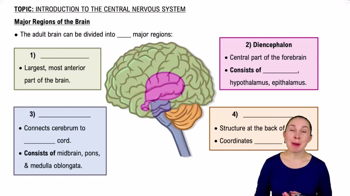
Major Regions of the Brain
Neurological Consequences of Traumatic Brain Injury in Infants
Traumatic brain injury in infants can cause seizures, paralysis, and developmental delays due to disrupted neural pathways and cell death. The immature brain is particularly sensitive, and injury can impair long-term neurological development, leading to permanent disabilities or death depending on injury severity and affected brain areas.
Recommended video:
The Cerebrum Example 4
Related Practice
Textbook Question
1
views
Textbook Question
What kinds of problems are associated with the presence of lesions in the Wernicke's area and the Broca's area?
4
views
Textbook Question
A police officer has just stopped Bill on suspicion of driving while intoxicated. The officer asks Bill to walk the yellow line on the road and then to place the tip of his index finger on the tip of his nose. How would these activities indicate Bill's level of sobriety? Which part of the brain is being tested by these activities?
1
views
