Ch. 4 Histology
Amerman - Human Anatomy & Physiology 2nd Edition
Amerman2nd EditionHuman Anatomy & PhysiologyISBN: 9780136873822Not the one you use?Change textbook
Chapter 4, Problem 10

Match the following types of connective tissue with their correct location(s). 
Hyaline cartilage           
Elastic cartilage           
Smooth muscle           
Dense irregular connective tissue           
Fibrocartilage
Cardiac muscle
Dense regular elastic tissue
Reticular connective tissue 
a. Dermis, surrounding joints, organs
b. Most hollow organs, eye, skin
c. Large arteries, certain ligaments
d. Ear and epiglottis
e. Lymph nodes, spleen, liver
f. Freely moveable joints
g. Intervertebral discs, knee joint
h. Heart

Verified step by step guidance
1
Step 1: Understand the problem. The task is to match each type of connective tissue or muscle tissue with its correct location(s) in the body. This requires knowledge of the structure and function of each tissue type and where it is typically found.
Step 2: Review the characteristics and locations of each tissue type: - Hyaline cartilage: Found in areas like freely movable joints, the nose, and the trachea. - Elastic cartilage: Found in flexible structures like the ear and epiglottis. - Smooth muscle: Found in the walls of most hollow organs, the skin, and the eye. - Dense irregular connective tissue: Found in the dermis of the skin, surrounding joints, and organs. - Fibrocartilage: Found in intervertebral discs and knee joints. - Cardiac muscle: Found exclusively in the heart. - Dense regular elastic tissue: Found in large arteries and certain ligaments. - Reticular connective tissue: Found in lymph nodes, spleen, and liver.
Step 3: Match each tissue type to its corresponding location(s) based on the descriptions provided: - Hyaline cartilage matches with 'f. Freely movable joints'. - Elastic cartilage matches with 'd. Ear and epiglottis'. - Smooth muscle matches with 'b. Most hollow organs, eye, skin'. - Dense irregular connective tissue matches with 'a. Dermis, surrounding joints, organs'. - Fibrocartilage matches with 'g. Intervertebral discs, knee joint'. - Cardiac muscle matches with 'h. Heart'. - Dense regular elastic tissue matches with 'c. Large arteries, certain ligaments'. - Reticular connective tissue matches with 'e. Lymph nodes, spleen, liver'.
Step 4: Verify the matches by cross-referencing the characteristics of each tissue type with its location(s) to ensure accuracy. For example, elastic cartilage is highly flexible, making it suitable for the ear and epiglottis, while fibrocartilage is tough and found in weight-bearing areas like intervertebral discs.
Step 5: Organize the final matches in a clear format for review or study purposes. For example: - Hyaline cartilage: f. Freely movable joints - Elastic cartilage: d. Ear and epiglottis - Smooth muscle: b. Most hollow organs, eye, skin - Dense irregular connective tissue: a. Dermis, surrounding joints, organs - Fibrocartilage: g. Intervertebral discs, knee joint - Cardiac muscle: h. Heart - Dense regular elastic tissue: c. Large arteries, certain ligaments - Reticular connective tissue: e. Lymph nodes, spleen, liver

Verified video answer for a similar problem:

This video solution was recommended by our tutors as helpful for the problem above.
Was this helpful?

Key Concepts

Here are the essential concepts you must grasp in order to answer the question correctly.

Types of Connective Tissue

Connective tissues are diverse groups of tissues that support, bind, and protect other tissues and organs in the body. They include various types such as cartilage, bone, adipose, and blood, each with specific functions and locations. Understanding the characteristics of each type is essential for identifying their roles in the body.
Recommended video:
Guided course
02:46
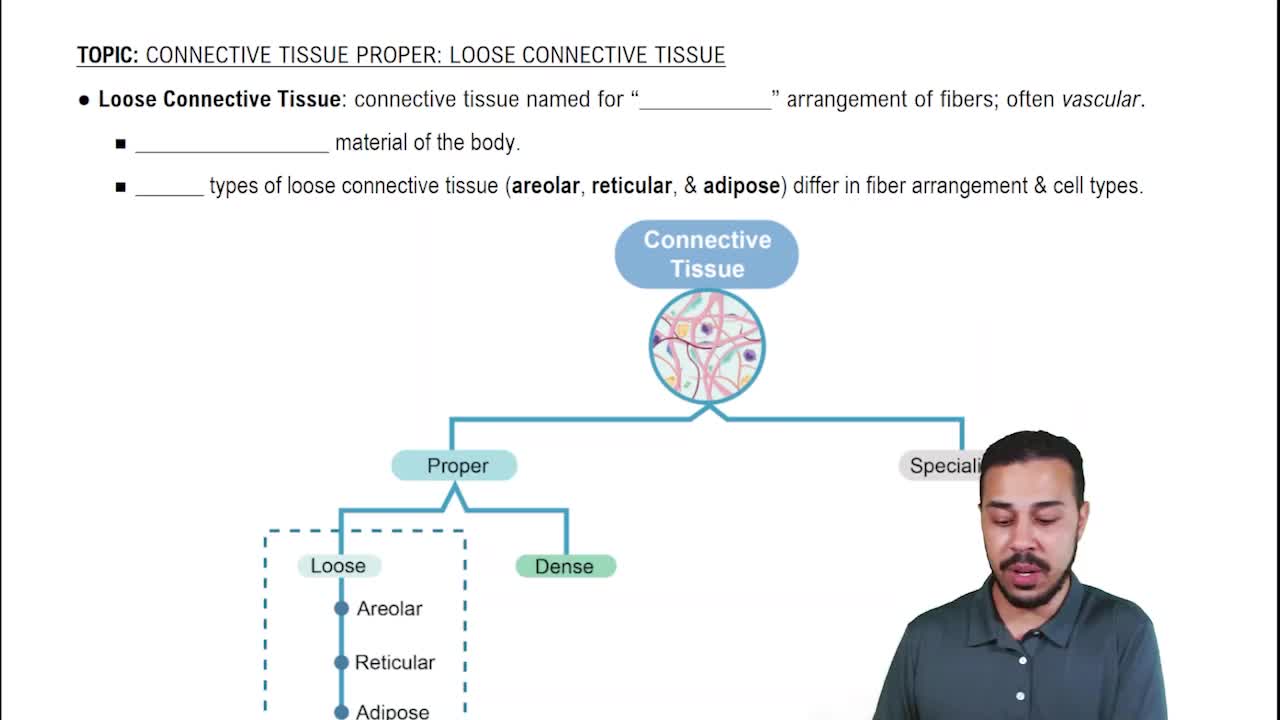
Loose Connective Tissue

Cartilage Types and Locations

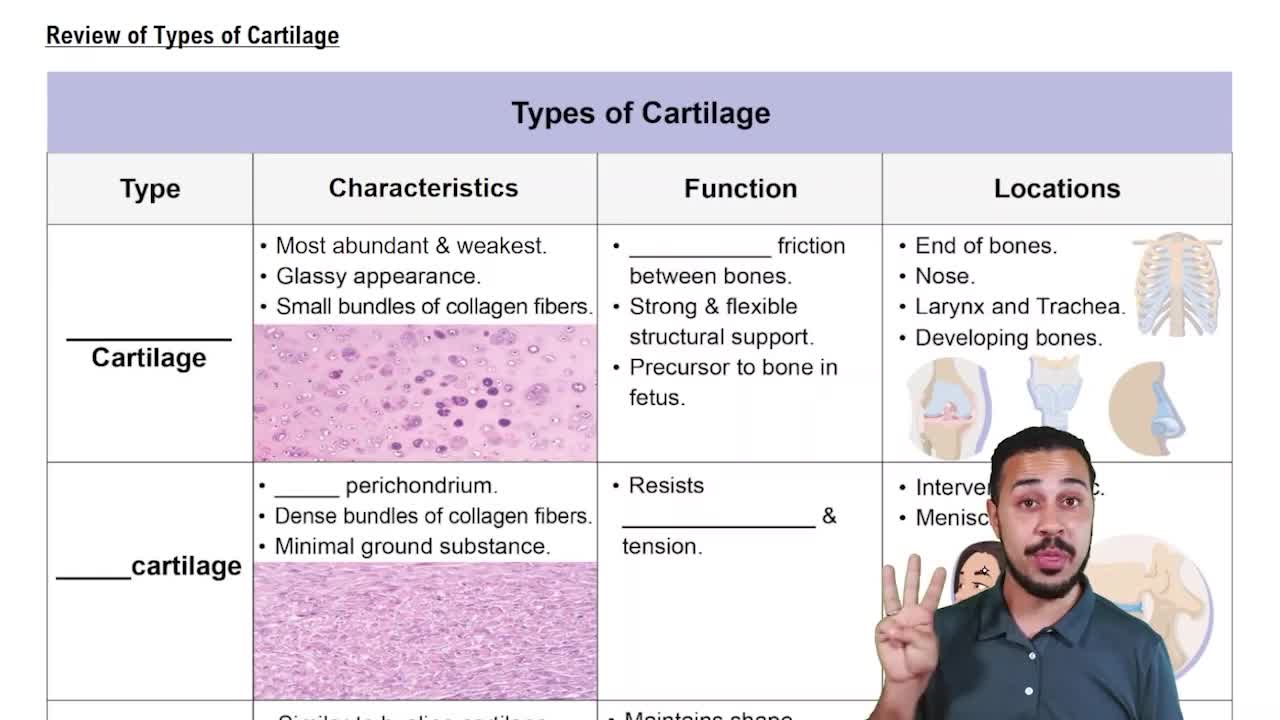
Cartilage is a flexible connective tissue that comes in three main types: hyaline, elastic, and fibrocartilage. Hyaline cartilage provides support and flexibility, found in joints and the rib cage; elastic cartilage offers more elasticity, located in the ear and epiglottis; while fibrocartilage is tough and found in intervertebral discs and knee joints, providing strength and shock absorption.
Recommended video:
Guided course
09:22
Review of Types of Cartilage

Muscle Tissue Types

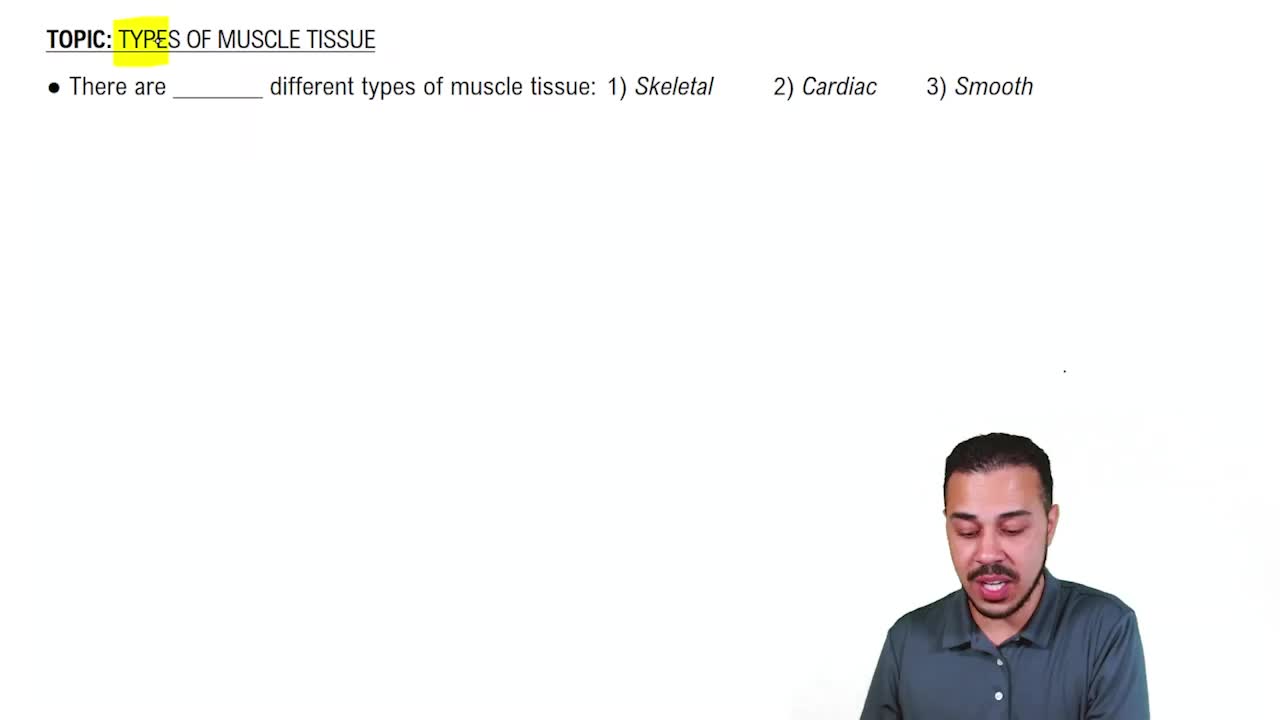
Muscle tissue is categorized into three types: skeletal, cardiac, and smooth muscle. Skeletal muscle is under voluntary control and moves bones; cardiac muscle is involuntary and makes up the heart; smooth muscle is also involuntary and lines hollow organs. Each type has distinct locations and functions, crucial for understanding their roles in the body.
Recommended video:
Guided course
00:36
3 Types of Muscle Tissue
Related Practice