Ch. 4 Histology
Amerman - Human Anatomy & Physiology 2nd Edition
Amerman2nd EditionHuman Anatomy & PhysiologyISBN: 9780136873822Not the one you use?Change textbook
Chapter 4, Problem 11

Which of the following statements about muscle tissue is false?
a. Smooth muscle tissue is involuntary, and the cells are nonstriated.
b. Cardiac muscle tissue is involuntary, and the cells are striated.
c. Skeletal muscle fibers are joined by intercalated discs.
d. Skeletal muscle fibers are long and cylindrical striated cells.

Verified step by step guidance
1
Step 1: Understand the characteristics of the three types of muscle tissue: skeletal, cardiac, and smooth. Each type has unique structural and functional properties.
Step 2: Recall that smooth muscle tissue is involuntary, meaning it is not under conscious control, and its cells are nonstriated (lacking visible bands or stripes).
Step 3: Remember that cardiac muscle tissue is also involuntary, but its cells are striated (having visible bands or stripes) and connected by intercalated discs, which allow for synchronized contraction.
Step 4: Note that skeletal muscle fibers are voluntary, striated, and long cylindrical cells. They are not joined by intercalated discs, as this feature is specific to cardiac muscle tissue.
Step 5: Compare the statements provided in the question to the characteristics of each muscle type. Identify the false statement by recognizing that skeletal muscle fibers are not joined by intercalated discs, making statement 'c' false.

Verified video answer for a similar problem:

This video solution was recommended by our tutors as helpful for the problem above.
Was this helpful?

Key Concepts

Here are the essential concepts you must grasp in order to answer the question correctly.

Types of Muscle Tissue

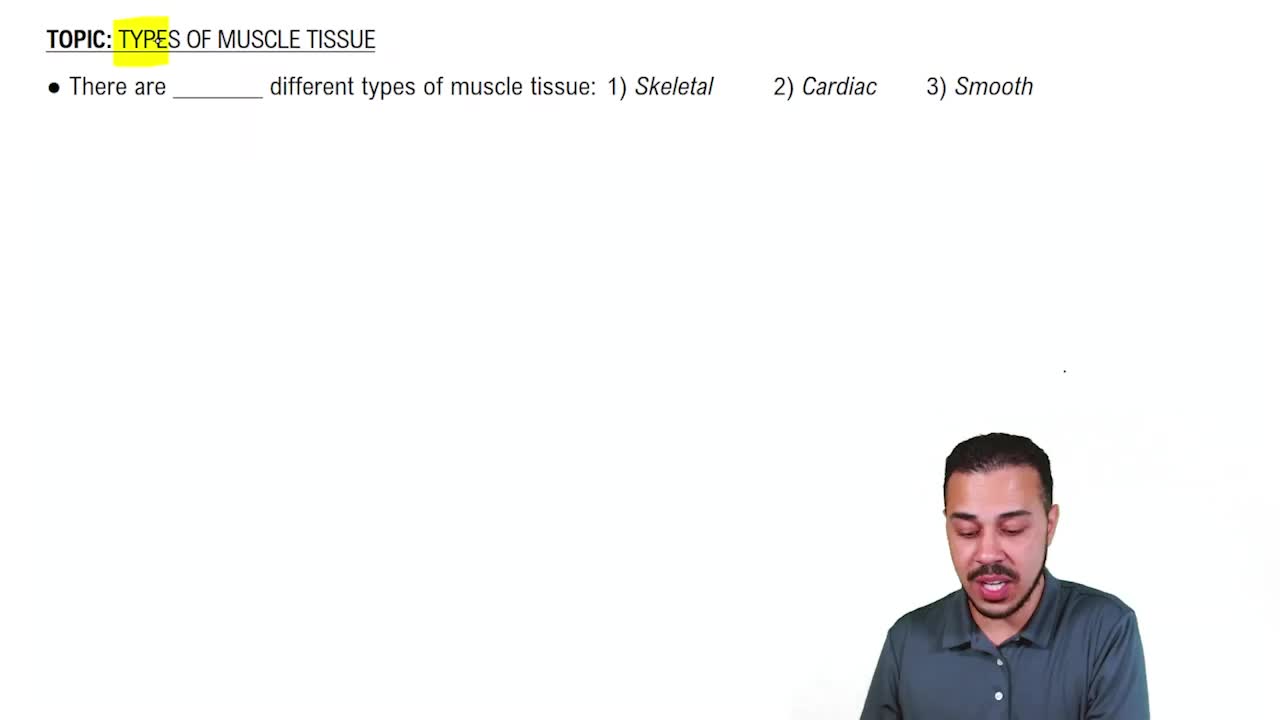
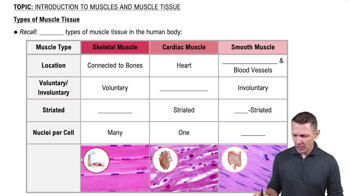
Muscle tissue is classified into three main types: skeletal, cardiac, and smooth. Skeletal muscle is voluntary and striated, allowing for conscious movement. Cardiac muscle is involuntary and striated, found only in the heart, while smooth muscle is also involuntary but non-striated, located in walls of hollow organs. Understanding these distinctions is crucial for identifying characteristics and functions of each muscle type.
Recommended video:
Guided course
00:36
3 Types of Muscle Tissue

Striations in Muscle Tissue

Striations refer to the alternating light and dark bands seen in skeletal and cardiac muscle tissues under a microscope. These bands are due to the organized arrangement of actin and myosin filaments, which are responsible for muscle contraction. In contrast, smooth muscle lacks these striations, which is indicative of its different structure and function. Recognizing the presence or absence of striations helps differentiate between muscle types.
Recommended video:
Guided course
6:31
Types of Muscle Tissue

Intercalated Discs

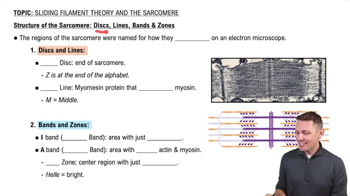
Intercalated discs are specialized connections between cardiac muscle cells that facilitate synchronized contraction of the heart. These structures contain gap junctions and desmosomes, allowing for rapid electrical communication and mechanical stability. Skeletal muscle fibers do not have intercalated discs; instead, they are multinucleated and work independently. Understanding the role of intercalated discs is essential for comprehending cardiac muscle function.
Recommended video:
Guided course
6:01
Structure of the Sarcomere: Bands, Zones, Discs & Lines
Related Practice
Textbook Question

Each of the following statements is false. Correct each to make a true statement.

Mucous membranes are composed of mesothelium and the underlying loose connective tissue.

4
views

Textbook Question

Match the following types of connective tissue with their correct location(s). 

Hyaline cartilage           

Elastic cartilage           

Smooth muscle           

Dense irregular connective tissue           

Fibrocartilage

Cardiac muscle

Dense regular elastic tissue

Reticular connective tissue 

a. Dermis, surrounding joints, organs

b. Most hollow organs, eye, skin

c. Large arteries, certain ligaments

d. Ear and epiglottis

e. Lymph nodes, spleen, liver

f. Freely moveable joints

g. Intervertebral discs, knee joint

h. Heart

1
views
Textbook Question

Mark the following statements as true or false. If a statement is false, correct it to make a true statement.

Fibrocartilage provides a smooth surface on which bones may articulate with little friction.

1
views
Textbook Question

Mark the following statements as true or false. If a statement is false, correct it to make a true statement.

The ECM of bone tissue consists exclusively of calcium phosphate crystals.

4
views
Textbook Question

Each of the following statements is false. Correct each to make a true statement.

Mesothelial cells secrete mucus.

1
views
Textbook Question

____are the cells of nervous tissue that send and receive messages, and ____ are the supporting cells of nervous tissue.

An ____ carries a nerve impulse toward a neuron cell body, and a(n) ____carries a nerve impulse away from a neuron cell body.

1
views