What do you think the effect on the properties of water would be if oxygen and hydrogen had equal electronegativity?
Verified step by step guidance
1
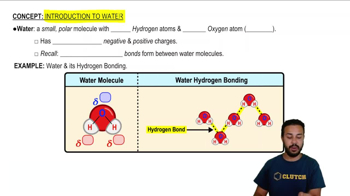
Understand that water (H2O) is a polar molecule due to the difference in electronegativity between oxygen and hydrogen, where oxygen is more electronegative.
Recognize that this difference in electronegativity causes a partial negative charge on the oxygen atom and a partial positive charge on the hydrogen atoms, leading to hydrogen bonding between water molecules.
Consider that if oxygen and hydrogen had equal electronegativity, the electrons would be shared equally, resulting in a nonpolar molecule.
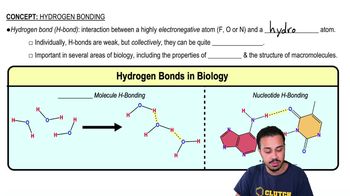
Reflect on how the lack of polarity would affect hydrogen bonding, as there would be no partial charges to facilitate these interactions.
Contemplate the broader implications on water's properties, such as its high surface tension, solvent capabilities, and specific heat capacity, which are largely due to its polar nature and hydrogen bonding.
Verified video answer for a similar problem:
This video solution was recommended by our tutors as helpful for the problem above.
Video duration:
1m
Play a video:
0 Comments
Key Concepts
Here are the essential concepts you must grasp in order to answer the question correctly.
Electronegativity
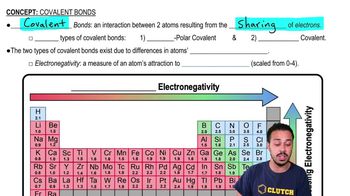
Electronegativity is a measure of an atom's ability to attract and hold onto electrons in a chemical bond. In the case of water (H2O), oxygen is significantly more electronegative than hydrogen, leading to polar covalent bonds. This polarity creates a dipole moment, resulting in unique properties of water, such as high surface tension and solvent capabilities.
The polarity of water arises from the unequal sharing of electrons between oxygen and hydrogen due to the difference in electronegativity. This polarity allows water molecules to form hydrogen bonds with each other, contributing to its high boiling point, specific heat capacity, and solvent properties. If oxygen and hydrogen had equal electronegativity, water would be nonpolar, drastically altering these properties.
Hydrogen bonding is a type of weak chemical bond that occurs when a hydrogen atom covalently bonded to a highly electronegative atom, like oxygen, experiences an attraction to another electronegative atom. In water, these bonds are responsible for many of its unique physical properties, including its high boiling point and ability to dissolve many substances. Equal electronegativity would eliminate hydrogen bonding, leading to a significant change in water's behavior and characteristics.

 1:31 minutes
 Verified step by step guidance
 04:28
04:28