Create a concept map to organize your understanding of the life-supporting properties of water. A sample map is in the answer section, but the value of this exercise is in the thinking and integrating you must do to create your own map.
Verified step by step guidance
1
Identify the key life-supporting properties of water, such as its solvent capabilities, high heat capacity, cohesion and adhesion, and its role in chemical reactions.
For each property, determine how it supports life. For example, water's solvent properties allow it to dissolve nutrients and waste products, facilitating transport and chemical reactions in organisms.
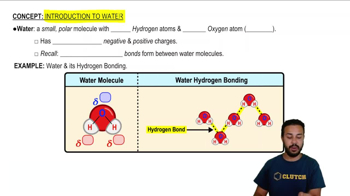
Consider the molecular structure of water, including its polar nature and hydrogen bonding, and how these contribute to its unique properties.
Organize these properties and their life-supporting roles into a hierarchical structure, starting with the most fundamental properties and branching out to their biological implications.
Review and refine your concept map to ensure clarity and completeness, making connections between different properties and their roles in supporting life.
Verified video answer for a similar problem:
This video solution was recommended by our tutors as helpful for the problem above.
Video duration:
1m
Play a video:
0 Comments
Key Concepts
Here are the essential concepts you must grasp in order to answer the question correctly.
Polarity of Water
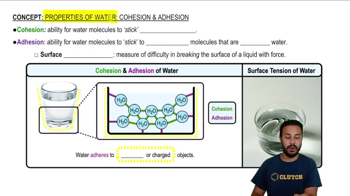
Water is a polar molecule, meaning it has a partial positive charge on one side and a partial negative charge on the other. This polarity allows water to form hydrogen bonds, which are crucial for many of its unique properties, such as high surface tension and solvent capabilities. Understanding polarity is essential for grasping how water interacts with other substances.
Cohesion refers to the attraction between water molecules, while adhesion is the attraction between water molecules and other substances. These properties are vital for processes like capillary action, which allows water to move through plants and soil. Recognizing these concepts helps explain water's role in biological systems and ecosystems.
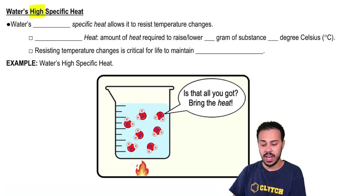
Water has a high specific heat capacity, meaning it can absorb a lot of heat without a significant change in temperature. This property is important for regulating climate and maintaining stable temperatures in organisms and environments. Understanding specific heat capacity is crucial for appreciating water's role in supporting life and influencing weather patterns.

 1:26 minutes
 Verified step by step guidance
 01:54
01:54