Ch. 6 Bones and Bone Tissue
Amerman - Human Anatomy & Physiology 2nd Edition
Amerman2nd EditionHuman Anatomy & PhysiologyISBN: 9780136873822Not the one you use?Change textbook
Chapter 6, Problem 5

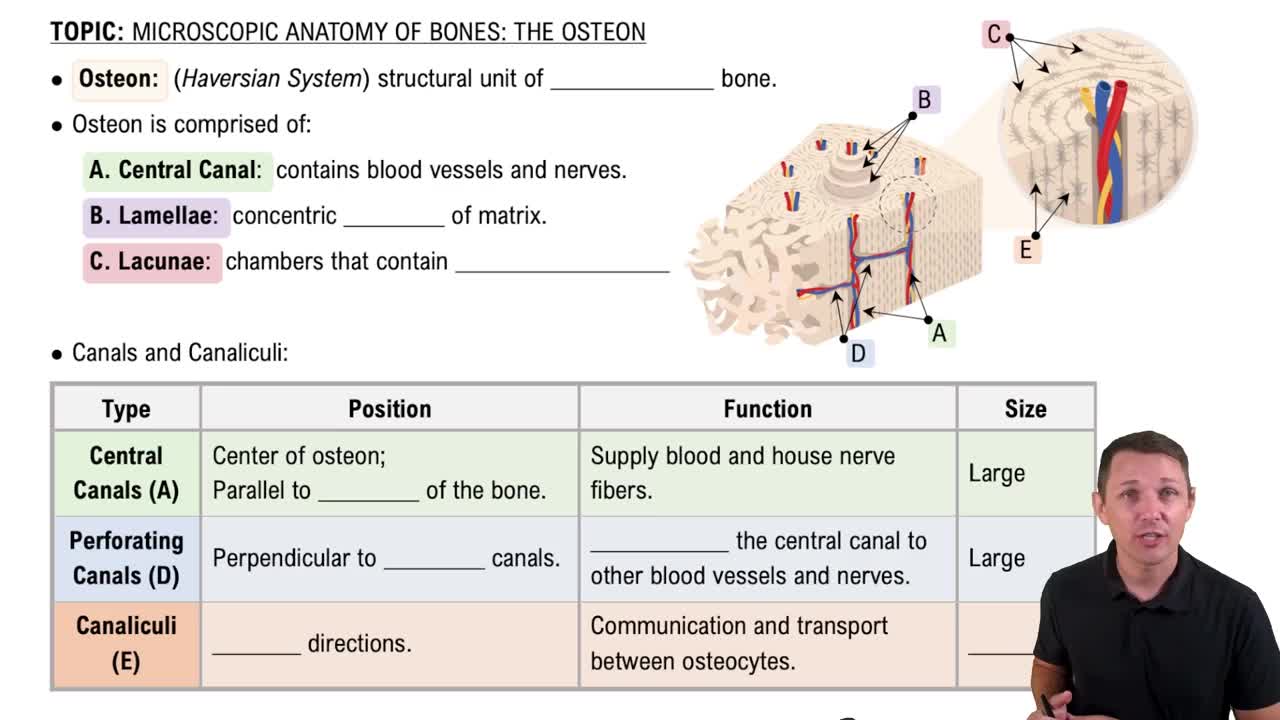
The subunit of compact bone is the _____ . It consists of rings of bone matrix called ______that surround a structure called the______ that contains blood vessels and nerves. Other structures called _______also contain blood vessels and nerves. Osteocytes are housed in_____and communicate via_______.

Verified step by step guidance
1
Identify the subunit of compact bone, which is the structural and functional unit of compact bone tissue. This is known as the osteon (or Haversian system).
Understand that the osteon consists of concentric rings of bone matrix called lamellae. These rings are arranged around a central canal.
Recognize that the central canal (Haversian canal) is the structure within the osteon that contains blood vessels and nerves, providing nutrients and communication to the bone cells.
Note that other structures, called perforating canals (Volkmann's canals), also contain blood vessels and nerves. These canals run perpendicular to the central canals and connect them, facilitating communication between osteons.
Learn that osteocytes, the mature bone cells, are housed in small spaces called lacunae. These osteocytes communicate with each other and exchange nutrients and waste through tiny channels called canaliculi, which connect the lacunae to each other and to the central canal.

Verified video answer for a similar problem:

This video solution was recommended by our tutors as helpful for the problem above.
Was this helpful?

Key Concepts

Here are the essential concepts you must grasp in order to answer the question correctly.

Osteon

The osteon, or Haversian system, is the fundamental structural unit of compact bone. It consists of concentric rings of bone matrix, known as lamellae, which surround a central canal that contains blood vessels and nerves. This organization allows for efficient nutrient delivery and waste removal, essential for bone health.
Recommended video:

Lamellae

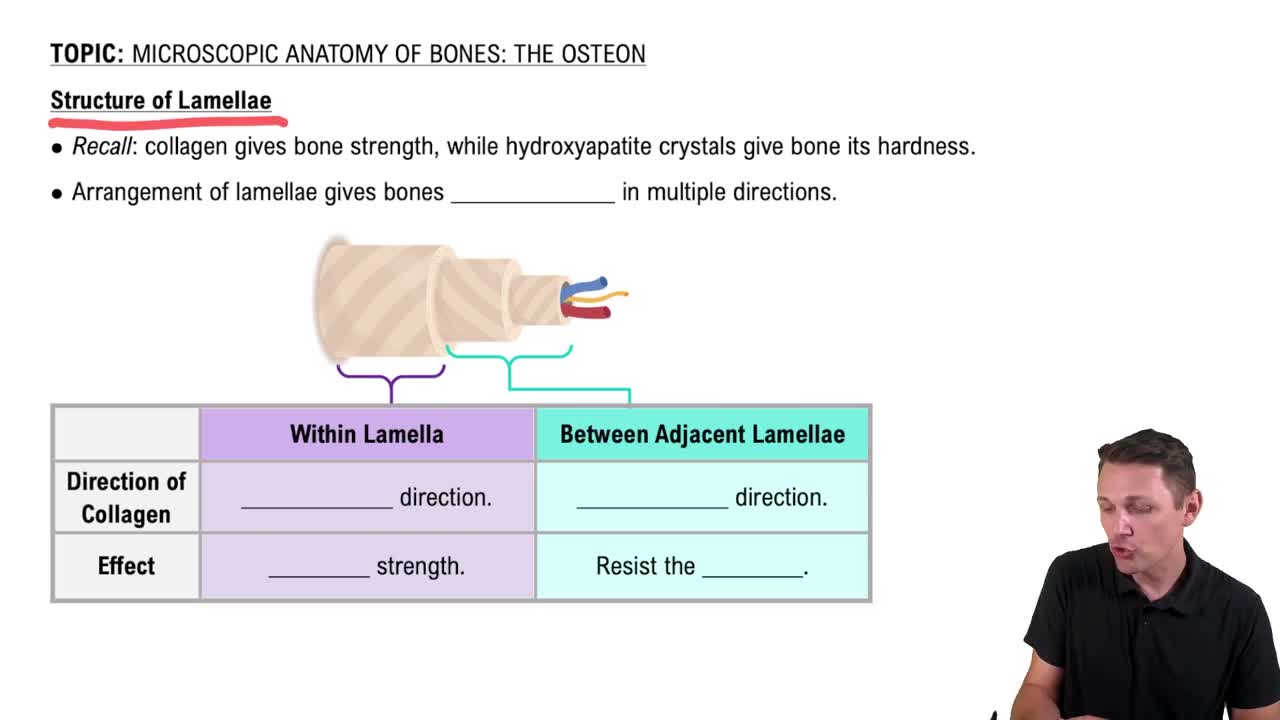
Lamellae are the thin layers of bone matrix that form the concentric rings of an osteon. Each lamella is composed of collagen fibers and mineralized matrix, providing strength and resilience to the bone. The arrangement of lamellae contributes to the overall structural integrity of compact bone.
Recommended video:
Guided course
2:52
Structure of Lamellae

Canaliculi

Canaliculi are tiny channels that connect osteocytes, the mature bone cells, within the bone matrix. These channels allow for the exchange of nutrients and waste products between osteocytes and the central canal, facilitating communication and maintaining bone health. Osteocytes extend their dendritic processes through canaliculi to form a network that supports cellular communication.
Recommended video:
Related Practice
Textbook Question

Mark the following statements about bone tissue as true or false. If a statement is false, correct it to make a true statement.


e. Osteoblasts are responsible for bone resorption, and osteoclasts are responsible for bone deposition.

2
views
Textbook Question

Mark the following statements about bone tissue as true or false. If a statement is false, correct it to make a true statement.


d. The collagen fibers of bone help it to resist torsion and tension.

1
views
Textbook Question

Which bones form via intramembranous ossification?


a. Irregular bones

b. Certain flat bones

c. Long bones

d. Short bones

e. More than one of the above

1
views
Textbook Question

The branching pieces of bone in spongy bone are called:


a. Lamellae

b. Lacunae

c. Osteoclasts

d. Trabeculae

2
views
Textbook Question

Mark the following statements about bone tissue as true or false. If a statement is false, correct it to make a true statement.


f. Osteocytes are mature and less active osteoblasts that have become surrounded by bone ECM.

3
views
Textbook Question

Of the following statements, identify those that are properties of intramembranous ossification, endochondral ossification, or both.

a. The bone is formed via a hyaline cartilage model.

b. Bone tissue forms from ossification centers.

c. Bone forms from within a mesenchyme membrane.

d. The early spongy bone is formed, after which the early compact bone develops.

e. The original primary bone is replaced with secondary bone.

f. A bone collar forms, followed by the early spongy bone.

1
views