Ch. 6 Bones and Bone Tissue
Amerman - Human Anatomy & Physiology 2nd Edition
Amerman2nd EditionHuman Anatomy & PhysiologyISBN: 9780136873822Not the one you use?Change textbook
Chapter 6, Problem 8

Of the following statements, identify those that are properties of intramembranous ossification, endochondral ossification, or both.
a. The bone is formed via a hyaline cartilage model.
b. Bone tissue forms from ossification centers.
c. Bone forms from within a mesenchyme membrane.
d. The early spongy bone is formed, after which the early compact bone develops.
e. The original primary bone is replaced with secondary bone.
f. A bone collar forms, followed by the early spongy bone.

Verified step by step guidance
1
Step 1: Understand the two processes of bone formation: Intramembranous ossification and Endochondral ossification. Intramembranous ossification occurs directly within a mesenchymal membrane, while endochondral ossification involves a hyaline cartilage model that is replaced by bone tissue.
Step 2: Analyze each statement and determine whether it applies to intramembranous ossification, endochondral ossification, or both. For example, statement (a) mentions a hyaline cartilage model, which is a hallmark of endochondral ossification.
Step 3: For statement (b), recognize that ossification centers are present in both processes. In intramembranous ossification, ossification centers form within the mesenchymal membrane, while in endochondral ossification, they form within the cartilage model.
Step 4: For statement (c), note that bone forming from a mesenchyme membrane is specific to intramembranous ossification, as this process does not involve a cartilage model.
Step 5: For statements (d), (e), and (f), identify the features that are shared by both processes. For example, the formation of early spongy bone followed by compact bone (d) and the replacement of primary bone with secondary bone (e) are common to both processes, while the formation of a bone collar (f) is specific to endochondral ossification.

Verified video answer for a similar problem:

This video solution was recommended by our tutors as helpful for the problem above.
Was this helpful?

Key Concepts

Here are the essential concepts you must grasp in order to answer the question correctly.

Intramembranous Ossification

Intramembranous ossification is a process where bone develops directly from mesenchymal tissue without a cartilage model. This type of ossification primarily occurs in the formation of flat bones, such as the skull and clavicle. The process involves the aggregation of mesenchymal cells that differentiate into osteoblasts, which then secrete bone matrix, leading to the formation of bone tissue.
Recommended video:
02:23
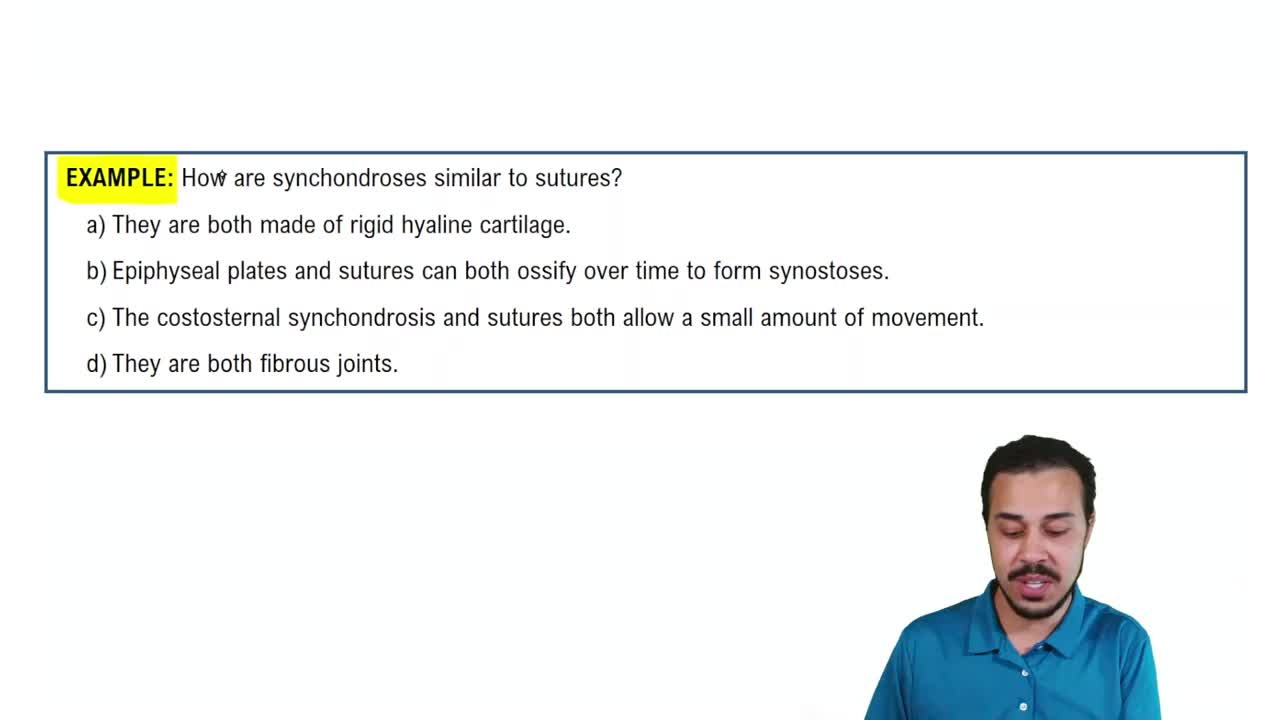
Structural Class: Cartilaginous Joints Example 1

Endochondral Ossification

Endochondral ossification is the process by which bone tissue is created through a cartilage model. This method is essential for the formation of long bones, such as the femur and humerus. In this process, hyaline cartilage serves as a precursor, which is gradually replaced by bone tissue as the cartilage is resorbed and ossification centers develop.
Recommended video:
02:23
Structural Class: Cartilaginous Joints Example 1

Bone Development and Remodeling

Bone development and remodeling involve the transformation of primary bone into secondary bone, which is denser and more organized. This process includes the formation of spongy bone followed by compact bone, and it is crucial for maintaining bone strength and integrity throughout life. Understanding these processes helps in identifying the characteristics of both intramembranous and endochondral ossification.
Recommended video:
4:48
Introduction to Human Development