Ch. 11 Cardiovascular System
Marieb - Essentials of Human Anatomy & Physiology 13th Edition
Marieb13th EditionEssentials of Human Anatomy & PhysiologyISBN: 9780135624340Not the one you use?Change textbook
Chapter 11, Problem 9

More than one choice may apply.
Which of these vessels is bilaterally symmetrical (i.e., one vessel of the pair occurs on each side of the body)?
a. Internal carotid artery
b. Brachiocephalic trunk
c. Azygos vein
d. Renal vein

Verified step by step guidance
1
Step 1: Understand the concept of bilateral symmetry in anatomy. Bilateral symmetry refers to structures that are paired and occur on both sides of the body, such as the left and right kidneys or arteries.
Step 2: Analyze each option provided in the question. Determine whether the vessel is paired and occurs symmetrically on both sides of the body.
Step 3: For option (a), the internal carotid artery is a paired vessel that supplies blood to the brain and occurs on both the left and right sides of the body. This makes it bilaterally symmetrical.
Step 4: For option (b), the brachiocephalic trunk is a single vessel that arises from the aortic arch and is not paired. It is not bilaterally symmetrical.
Step 5: For option (c), the azygos vein is a single vein that runs along the right side of the vertebral column and is not paired. For option (d), the renal veins are paired vessels that drain blood from the kidneys and occur on both sides of the body, making them bilaterally symmetrical.

Verified video answer for a similar problem:

This video solution was recommended by our tutors as helpful for the problem above.
Video duration:
2m
Was this helpful?

Key Concepts

Here are the essential concepts you must grasp in order to answer the question correctly.

Bilaterally Symmetrical Vessels

Bilaterally symmetrical vessels are those that have a corresponding counterpart on the opposite side of the body. This symmetry is important in anatomy as it reflects the organization of the vascular system, where paired structures often serve similar functions on either side of the midline.
Recommended video:
4:59
Blood Vessels

Internal Carotid Artery

The internal carotid arteries are major blood vessels that supply blood to the brain, neck, and face. They are paired vessels, with one artery on each side of the neck, making them bilaterally symmetrical. Understanding their anatomy is crucial for recognizing their role in cerebral circulation.
Recommended video:
14:43
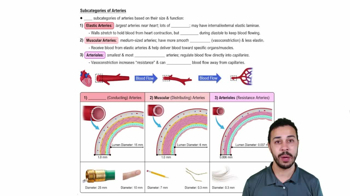
Subcategories of Arteries

Brachiocephalic Trunk

The brachiocephalic trunk is a large artery that branches off the aorta and supplies blood to the right arm and the head and neck. Unlike bilaterally symmetrical vessels, it is a singular structure that divides into the right common carotid and right subclavian arteries, thus lacking a counterpart on the left side.
Recommended video:
Guided course
02:52
The Front of the Trunk