
Textbook Question
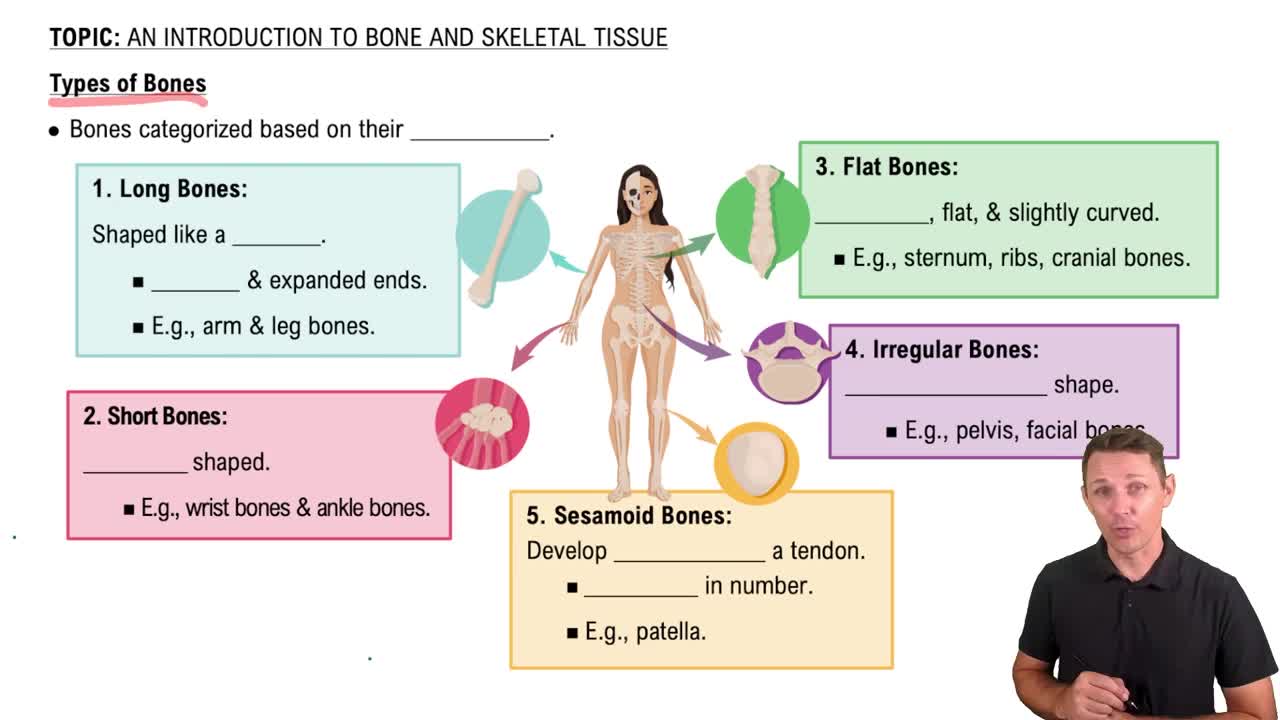
The part of the epiphysis that does not ossify during a person's lifetime is the:
a. Articular surface
b. Secondary ossification center
c. Diaphyseal notch
d. Nutrient foramen
1
views

 Verified step by step guidance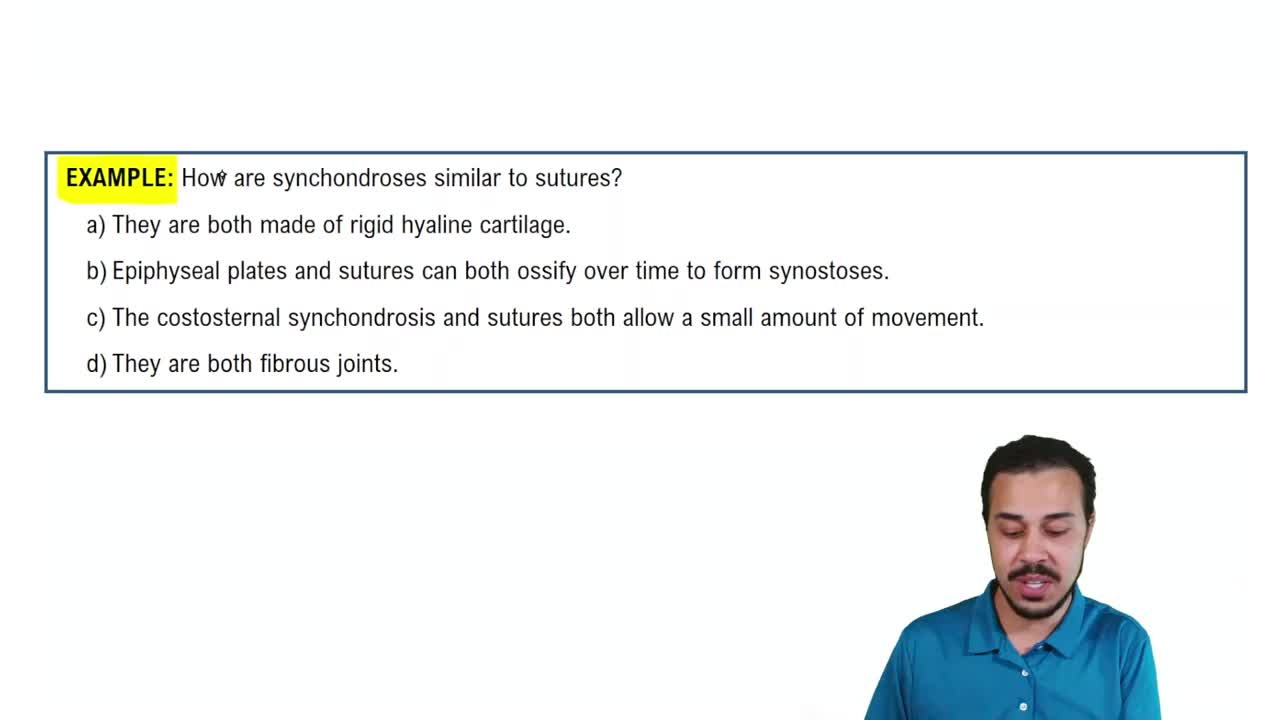
 02:23
02:23
 4:14
4:14 04:19
04:19The part of the epiphysis that does not ossify during a person's lifetime is the:
a. Articular surface
b. Secondary ossification center
c. Diaphyseal notch
d. Nutrient foramen
What is the difference between a primary and secondary ossification center in a long bone?
The subunit of compact bone is the _____ . It consists of rings of bone matrix called ______that surround a structure called the______ that contains blood vessels and nerves. Other structures called _______also contain blood vessels and nerves. Osteocytes are housed in_____and communicate via_______.
The branching pieces of bone in spongy bone are called:
a. Lamellae
b. Lacunae
c. Osteoclasts
d. Trabeculae
Mark the following statements about bone tissue as true or false. If a statement is false, correct it to make a true statement.
f. Osteocytes are mature and less active osteoblasts that have become surrounded by bone ECM.
Of the following statements, identify those that are properties of intramembranous ossification, endochondral ossification, or both.
a. The bone is formed via a hyaline cartilage model.
b. Bone tissue forms from ossification centers.
c. Bone forms from within a mesenchyme membrane.
d. The early spongy bone is formed, after which the early compact bone develops.
e. The original primary bone is replaced with secondary bone.
f. A bone collar forms, followed by the early spongy bone.