List the similarities and differences among the three types of muscle tissue.
Verified step by step guidance
1
Step 1: Identify the three types of muscle tissue: skeletal muscle, cardiac muscle, and smooth muscle.
Step 2: Describe the similarities among the three types, such as their ability to contract and generate force, and the presence of actin and myosin filaments as contractile proteins.
Step 3: Explain the differences in structure, including skeletal muscle being striated and multinucleated, cardiac muscle being striated with intercalated discs, and smooth muscle being non-striated with spindle-shaped cells.
Step 4: Discuss functional differences, such as skeletal muscle being voluntary and responsible for body movement, cardiac muscle being involuntary and found only in the heart, and smooth muscle being involuntary and found in walls of hollow organs.
Step 5: Summarize differences in control mechanisms, noting that skeletal muscle is controlled by the somatic nervous system, while cardiac and smooth muscles are controlled by the autonomic nervous system and influenced by hormones.
Verified video answer for a similar problem:
This video solution was recommended by our tutors as helpful for the problem above
Video duration:
1m
Play a video:
0 Comments
Key Concepts
Here are the essential concepts you must grasp in order to answer the question correctly.
Types of Muscle Tissue
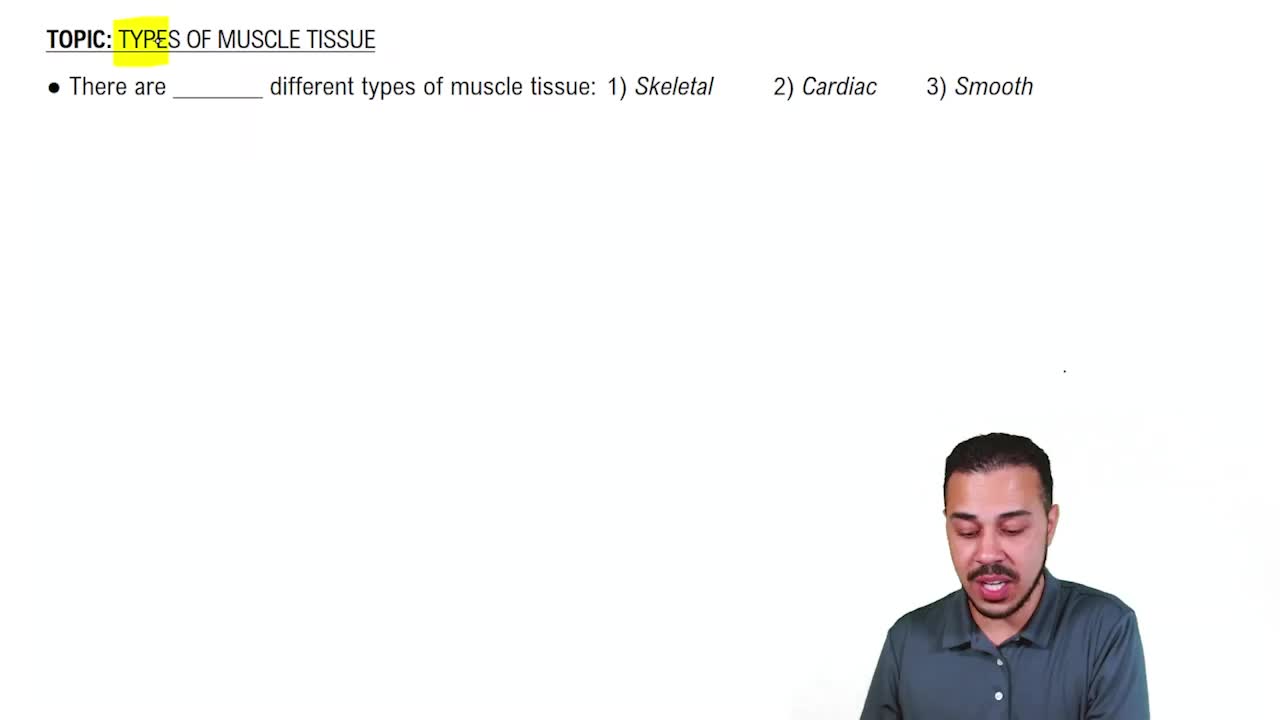
Muscle tissue is classified into three types: skeletal, cardiac, and smooth. Each type has distinct structures and functions, with skeletal muscles attached to bones, cardiac muscles found in the heart, and smooth muscles located in walls of internal organs.
The three muscle types differ in cell shape, striation, and nucleus number. Skeletal muscle fibers are long, cylindrical, multinucleated, and striated; cardiac muscle cells are branched, striated, and usually have one nucleus; smooth muscle cells are spindle-shaped, non-striated, and have a single nucleus.
Each muscle type has unique functions: skeletal muscles enable voluntary movement, cardiac muscle contracts involuntarily to pump blood, and smooth muscle controls involuntary movements in organs like the intestines and blood vessels.