Ch. 4 The Tissue Level of Organization
Martini - Fundamentals of Anatomy & Physiology 11th Edition
Martini, Nath, Bartholomew11th EditionFundamentals of Anatomy & PhysiologyISBN: 9780136874089Not the one you use?Change textbook
Chapter 4, Problem 25

Describe the fluid connective tissues in the human body. What are the main differences between fluid connective tissues and supporting connective tissues?

Verified step by step guidance
1
Begin by defining fluid connective tissues as types of connective tissue in the human body where the extracellular matrix is a liquid. The two main types are blood and lymph, which serve as transport mediums for nutrients, gases, wastes, and immune cells.
Explain the composition of fluid connective tissues: blood consists of plasma (the liquid matrix) and formed elements such as red blood cells, white blood cells, and platelets; lymph is a clear fluid derived from interstitial fluid that circulates in the lymphatic system.
Next, define supporting connective tissues, which include cartilage and bone. These tissues have a dense, solid extracellular matrix that provides structural support and protection to the body.
Highlight the main differences: fluid connective tissues have a liquid matrix allowing for transport and communication, whereas supporting connective tissues have a rigid or semi-rigid matrix designed for mechanical support and protection.
Summarize by noting that fluid connective tissues primarily function in transport and immune defense, while supporting connective tissues provide the framework and strength necessary for body structure and movement.

Verified video answer for a similar problem:

This video solution was recommended by our tutors as helpful for the problem above.
Video duration:
4m
Was this helpful?

Key Concepts

Here are the essential concepts you must grasp in order to answer the question correctly.

Fluid Connective Tissues

Fluid connective tissues are types of connective tissue characterized by a liquid extracellular matrix. In the human body, these include blood and lymph, which transport nutrients, gases, and waste products. Their cells are suspended in a fluid matrix, allowing for mobility and rapid transport throughout the body.
Recommended video:
Guided course
03:25
Connective Tissue Proper: Loose Connective Tissue Example 1

Supporting Connective Tissues

Supporting connective tissues provide structural support and protection to the body. They include cartilage and bone, which have a dense extracellular matrix rich in fibers and minerals. These tissues are less flexible but provide strength and rigidity necessary for the skeleton and other supportive functions.
Recommended video:
Guided course
02:19
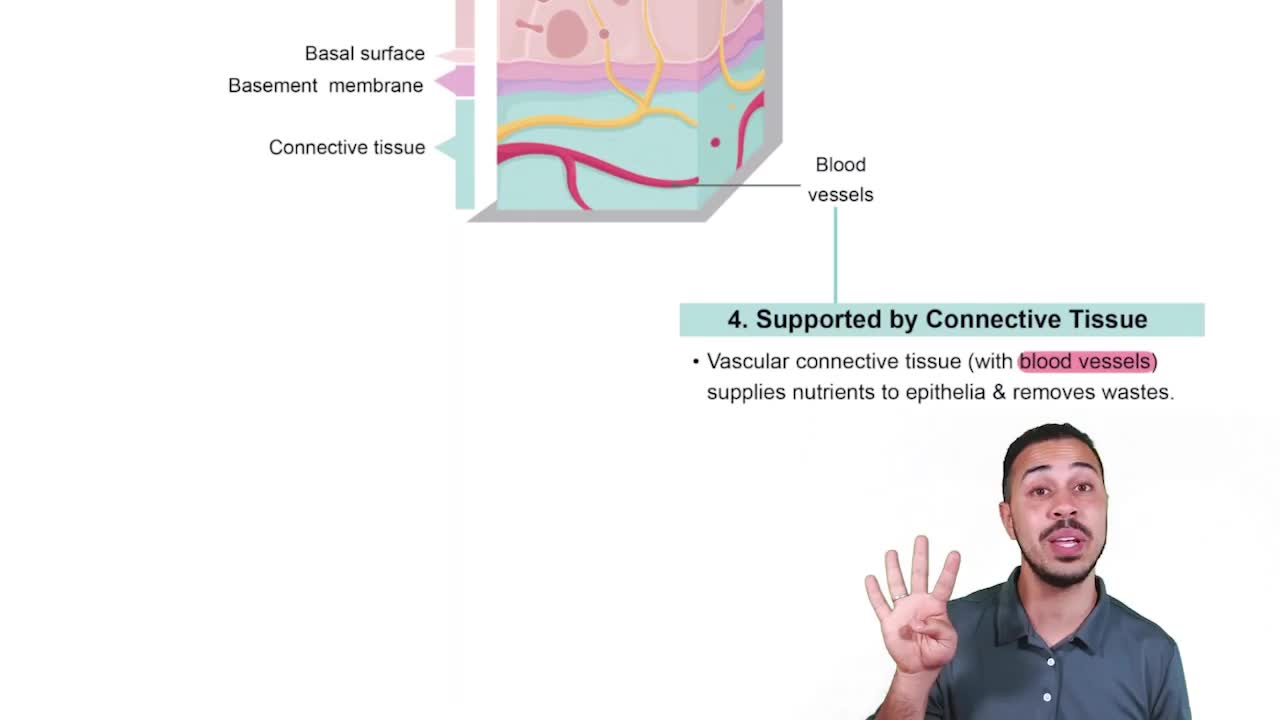
Characteristic 4: Supported by Connective Tissue

Differences Between Fluid and Supporting Connective Tissues

The main differences lie in their matrix composition and function: fluid connective tissues have a liquid matrix facilitating transport and communication, while supporting connective tissues have a solid or semi-solid matrix providing mechanical support. Additionally, fluid tissues are involved in circulation and immune responses, whereas supporting tissues maintain body structure.
Recommended video:
Guided course
02:19
Characteristic 4: Supported by Connective Tissue