Skip to main content
Analytical Chemistry
My Course
Learn
Exam Prep
AI Tutor
Study Guides
Flashcards
Explore
Try the app
My Course
Learn
Exam Prep
AI Tutor
Study Guides
Flashcards
Explore
Try the app
Back
Ionic Salts of Weak Acids and Bases quiz
You can tap to flip the card.
What is formed when an acid neutralizes a base?
You can tap to flip the card.
👆
What is formed when an acid neutralizes a base?
An ionic compound called a salt is formed.
Track progress
Control buttons has been changed to "navigation" mode.
1/15
Related flashcards
Related practice
Recommended videos
Ionic Salts of Weak Acids and Bases definitions
Ionic Salts of Weak Acids and Bases
15 Terms
Ionic Salts of Weak Acids and Bases
8. Monoprotic Acid-Base Equilibria
5 problems
Topic
Buffers
8. Monoprotic Acid-Base Equilibria
5 problems
Topic
8. Monoprotic Acid-Base Equilibria - Part 1 of 2
4 topics
12 problems
Chapter
8. Monoprotic Acid-Base Equilibria - Part 2 of 2
4 topics
12 problems
Chapter
Guided course
04:33
Ionic Salts
2
views
Guided course
02:28
Ionic Salts
2
views
Guided course
01:16
Ionic Salts
4
views
Terms in this set (15)
Hide definitions
What is formed when an acid neutralizes a base?
An ionic compound called a salt is formed.
What determines whether an ionic salt solution is neutral, acidic, or basic?
It depends on the acid-base properties of the cations and anions in the salt.
How are cations classified when analyzing ionic salts?
Cations are classified as transition metals, main group metals, or positive amines.
What charge must a transition metal cation have to be considered acidic?
A transition metal cation must have a charge of +2 or higher to be acidic.
What is the minimum charge required for a main group metal cation to be acidic?
A main group metal cation must have a charge of +3 or higher to be acidic.
How are positive amines classified in terms of acidity?
Positive amines are automatically considered acidic.
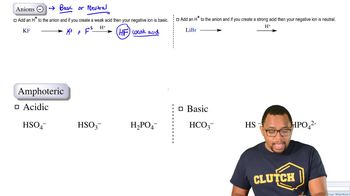
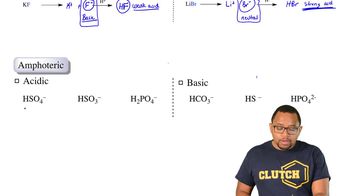
What is the rule for determining if an anion is basic or neutral?
Add an H+ to the anion; if it forms a weak acid, the anion is basic; if it forms a strong acid, the anion is neutral.
Why is F- considered a basic anion?
Because adding H+ to F- forms HF, which is a weak acid, making F- a basic anion.
Why is Br- considered a neutral anion?
Because adding H+ to Br- forms HBr, a strong acid, making Br- a neutral anion.
What is the overall solution type when a neutral cation is paired with a basic anion?
The solution will be basic.
What are amphoteric species?
Amphoteric species are compounds that can act as either an acid or a base.
Name two examples of acidic amphoteric species.
Bisulfate (HSO4-) and dihydrogen phosphate (H2PO4-) are acidic amphoteric species.
Name two examples of basic amphoteric species.
Bicarbonate (HCO3-) and hydrogen phosphate (HPO4^2-) are basic amphoteric species.
What property allows amphoteric species to act as both acids and bases?
They possess hydrogens (can donate H+) and negative charges (can accept H+).
How are amphoteric species classified as acidic or basic?
They are classified based on their Ka values and their tendency to act as acids or bases.
 BackBack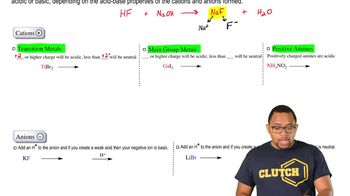
 04:33
04:33