Skip to main content
Analytical Chemistry
My Course
Learn
Exam Prep
AI Tutor
Study Guides
Flashcards
Explore
Try the app
My Course
Learn
Exam Prep
AI Tutor
Study Guides
Flashcards
Explore
Try the app
Back
Ionic Salts of Weak Acids and Bases definitions
You can tap to flip the card.
Ionic Salt
You can tap to flip the card.
👆
Ionic Salt
A compound formed from acid-base neutralization, consisting of positive and negative ions, which can yield acidic, basic, or neutral solutions.
Track progress
Control buttons has been changed to "navigation" mode.
1/15
Related flashcards
Related practice
Recommended videos
Ionic Salts of Weak Acids and Bases quiz
Ionic Salts of Weak Acids and Bases
15 Terms
Ionic Salts of Weak Acids and Bases
8. Monoprotic Acid-Base Equilibria
5 problems
Topic
Buffers
8. Monoprotic Acid-Base Equilibria
5 problems
Topic
8. Monoprotic Acid-Base Equilibria - Part 1 of 2
4 topics
12 problems
Chapter
8. Monoprotic Acid-Base Equilibria - Part 2 of 2
4 topics
12 problems
Chapter
Guided course
04:33
Ionic Salts
2
views
Guided course
02:28
Ionic Salts
2
views
Guided course
01:16
Ionic Salts
4
views
Terms in this set (15)
Hide definitions
Ionic Salt
A compound formed from acid-base neutralization, consisting of positive and negative ions, which can yield acidic, basic, or neutral solutions.
Cation
A positively charged ion in an ionic salt, classified by its group and charge to determine its acidic or neutral nature.
Anion
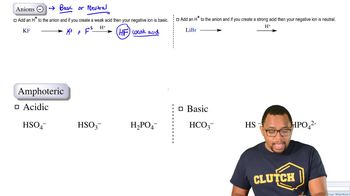
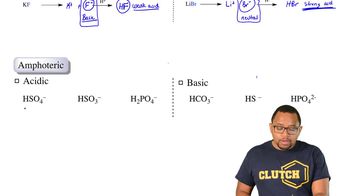
A negatively charged ion in an ionic salt, whose basicity or neutrality is determined by the acid formed when H+ is added.
Transition Metal
A metal from the central block of the periodic table; with a charge of +2 or higher, it forms acidic cations.
Main Group Metal
A metal from groups 1A to 4A; requires a charge of +3 or higher to act as an acidic cation in salts.
Positive Amine
A cation containing nitrogen and hydrogen, sometimes with carbon, always considered acidic in ionic salts.
Conjugate Base
The species formed when an acid donates a proton; its strength determines if an anion is basic or neutral.
Weak Acid
A substance that partially ionizes in water; its conjugate base is considered basic in salt solutions.
Strong Acid
A substance that completely ionizes in water; its conjugate base is so weak it is considered neutral.
Amphoteric Species
A compound capable of acting as both an acid and a base, classified as acidic or basic based on its Ka value.
Bisulfate
An acidic amphoteric ion, able to donate or accept protons, commonly found in salt solutions.
Bicarbonate
A basic amphoteric ion, able to act as an acid or base, often present in buffer systems.
Ka Value
A numerical measure of acid strength, used to classify amphoteric species as acidic or basic.
Neutral Solution
A solution where the cation and anion do not contribute acidic or basic properties, resulting in a balanced pH.
Basic Solution
A solution formed when the cation is neutral and the anion is basic, leading to a pH above 7.
 BackBack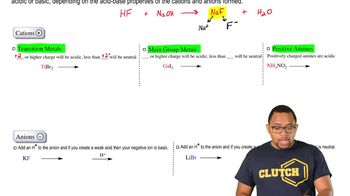
 04:33
04:33