Back

Chemical Thermodynamics: Gibbs Free Energy quiz

Control buttons has been changed to "navigation" mode.
1/15
  • What does a negative value of Gibbs free energy (ΔG < 0) indicate about a reaction?

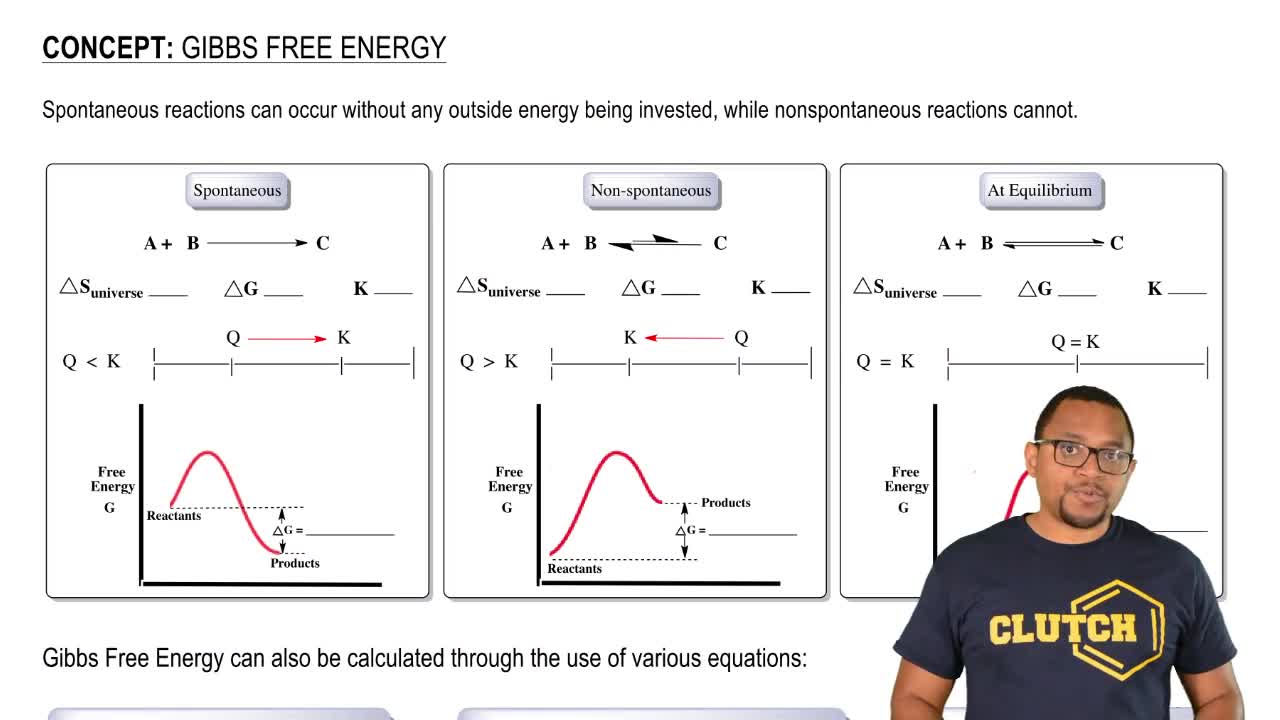
    A negative ΔG indicates that the reaction is spontaneous and can occur naturally without outside energy input.
  • What is the relationship between the reaction quotient (Q) and the equilibrium constant (K) for a spontaneous reaction?

    For a spontaneous reaction, Q is less than K (Q < K), meaning the reaction will proceed in the forward direction to reach equilibrium.
  • How does the entropy of the universe (ΔS_universe) relate to spontaneity?

    A spontaneous reaction requires ΔS_universe to be greater than 0, following the second law of thermodynamics.
  • What is the value of ΔG, K, and Q at equilibrium?

    At equilibrium, ΔG = 0, K = 1, and Q = K.
  • What does a positive value of Gibbs free energy (ΔG > 0) indicate about a reaction?

    A positive ΔG means the reaction is non-spontaneous and requires energy input to proceed.
  • In an energy diagram, how do the energy levels of reactants and products compare for a spontaneous reaction?

    For a spontaneous reaction, the products are at a lower energy level than the reactants.
  • What is the equation for Gibbs free energy under non-standard conditions?

    ΔG = ΔH - TΔS, where ΔH is enthalpy change, T is temperature in Kelvin, and ΔS is entropy change.
  • How is standard Gibbs free energy (ΔG°) related to the equilibrium constant (K)?

    ΔG° = -RT ln K, where R is the gas constant and T is temperature in Kelvin.
  • What are the standard conditions for calculating Gibbs free energy?

    Standard conditions are 1 atmosphere pressure, 1 molar concentration, and 25°C (298 K) temperature.
  • What does it mean if K > 1 for a reaction?

    If K > 1, the reaction favors product formation and is likely spontaneous under standard conditions.
  • What is the significance of Q > K in a reaction?

    If Q > K, the reaction will shift in the reverse direction to reach equilibrium, favoring reactants.
  • How can you calculate ΔG under non-standard conditions using ΔG°?

    ΔG = ΔG° + RT ln Q, where Q is the reaction quotient.
  • What is the value of ΔS_universe for a reaction at equilibrium?

    At equilibrium, ΔS_universe is equal to 0.
  • Why is determining spontaneity using Gibbs free energy more useful than using ΔH and ΔS alone?

    Gibbs free energy combines both enthalpy and entropy changes, providing a single criterion for spontaneity.
  • What does it mean if the products are higher in energy than the reactants in an energy diagram?

    If products are higher in energy, ΔG is positive and the reaction is non-spontaneous (endergonic).