Back

Chemical Thermodynamics: Gibbs Free Energy definitions

Control buttons has been changed to "navigation" mode.
1/15
  • Gibbs Free Energy

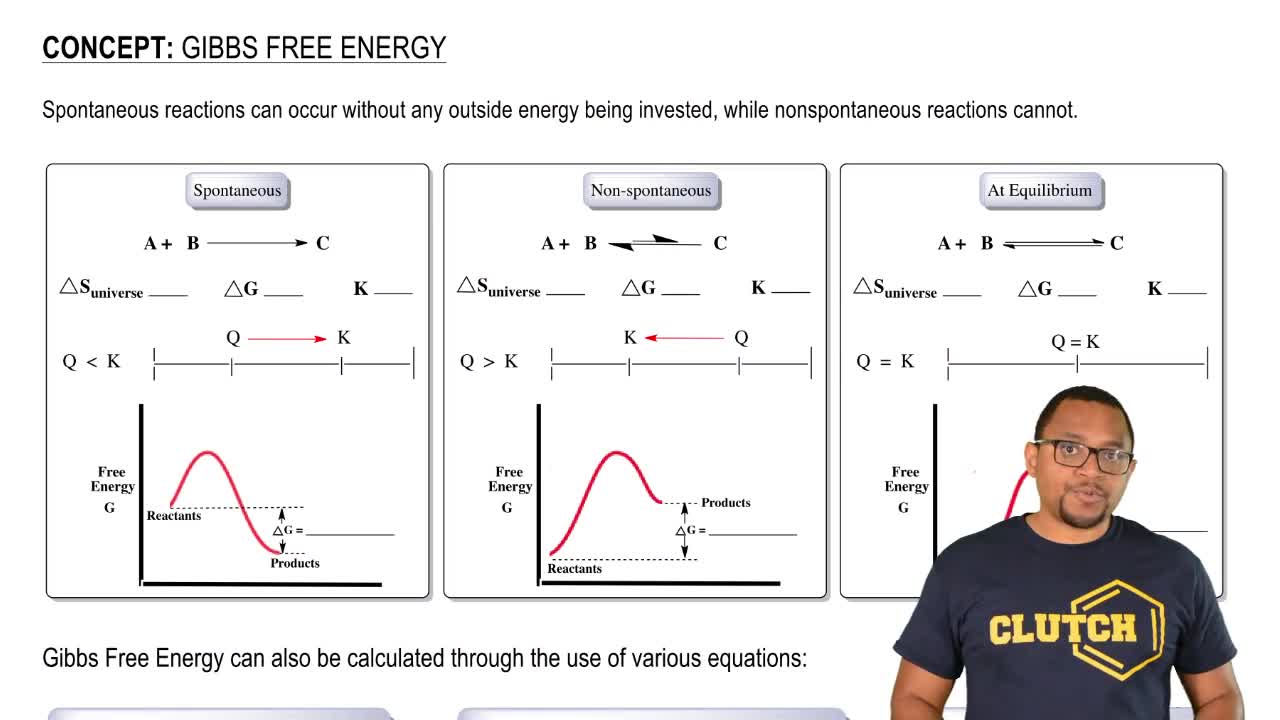
    A thermodynamic quantity used to predict if a reaction occurs naturally, calculated from enthalpy and entropy changes.
  • Spontaneous Reaction

    A process that proceeds without external energy input, typically with negative Gibbs free energy and positive universe entropy.
  • Non-Spontaneous Reaction

    A process requiring energy input to proceed, characterized by positive Gibbs free energy and negative universe entropy.
  • Equilibrium

    A state where forward and reverse reaction rates are equal, with zero Gibbs free energy change and reaction quotient equal to equilibrium constant.
  • Entropy

    A measure of disorder or randomness, with universe increase favoring spontaneous processes according to the second law of thermodynamics.
  • Enthalpy

    A thermodynamic property representing heat content, used in calculating Gibbs free energy changes.
  • Equilibrium Constant

    A value expressing the ratio of product to reactant concentrations at equilibrium, influencing reaction spontaneity.
  • Reaction Quotient

    A ratio of product to reactant concentrations at any point, indicating direction needed to reach equilibrium.
  • Standard Conditions

    Reference state with 1 atm pressure, 1 M concentration, and 25°C temperature, used for thermodynamic calculations.
  • Energy Diagram

    A graphical representation showing energy changes of reactants and products, with y-axis as Gibbs free energy.
  • Exergonic Process

    A reaction with negative Gibbs free energy, releasing energy and favoring product formation.
  • Endergonic Process

    A reaction with positive Gibbs free energy, requiring energy input and favoring reactant formation.
  • Gas Constant

    A physical constant (8.314 J/mol·K) used in thermodynamic equations involving energy and temperature.
  • Second Law of Thermodynamics

    A principle stating that universe entropy increases in spontaneous processes, guiding reaction direction.
  • Temperature

    A variable, often in Kelvin, affecting Gibbs free energy and reaction spontaneity in thermodynamic equations.