Back

Analysis of Variance (f-Test) quiz

Control buttons has been changed to "navigation" mode.
1/15
  • What is the F-test used for in analytical chemistry?

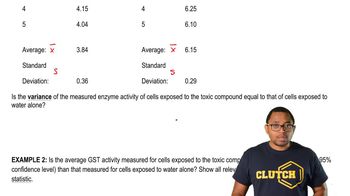
    The F-test is used to compare the variances of two populations to determine if they are significantly different.
  • How is variance related to standard deviation?

    Variance is the square of the standard deviation.
  • How do you calculate the F value (F calculated) in an F-test?

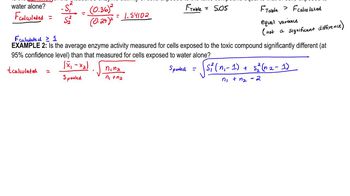
    F calculated is found by dividing the square of the larger standard deviation by the square of the smaller standard deviation.
  • Why is the larger standard deviation always placed in the numerator when calculating F?

    Placing the larger standard deviation in the numerator ensures that F calculated is always equal to or greater than 1.
  • What does it mean if F calculated is less than the F table value?

    If F calculated is less than the F table value, the variances are considered equal and there is no significant difference.
  • What formulas are used when variances are considered equal in an F-test?

    When variances are equal, the pooled standard deviation (s pooled) and a specific t calculated formula are used.
  • What does it indicate if F calculated is greater than the F table value?

    If F calculated is greater than the F table value, it indicates that the variances are significantly different (unequal).
  • What changes in the t-test calculation when variances are unequal?

    A different formula for t calculated and for degrees of freedom is used when variances are unequal.
  • What are degrees of freedom in the context of the F-test?

    Degrees of freedom refer to the number of independent values used to calculate each standard deviation, one for each population.
  • How do you use the F table in the F-test?

    You use the degrees of freedom for each standard deviation to find the appropriate F table value for comparison with F calculated.
  • What is the purpose of comparing F calculated to the F table value?

    Comparing F calculated to the F table value determines whether the difference in variances is statistically significant.
  • What is the consequence of finding equal variances in an F-test for subsequent t-tests?

    If variances are equal, the pooled variance is used in the t-test calculation.
  • What is the consequence of finding unequal variances in an F-test for subsequent t-tests?

    If variances are unequal, a different formula for t and degrees of freedom must be used.
  • What does the F table provide in the context of the F-test?

    The F table provides critical values based on the degrees of freedom for each population's standard deviation.
  • Why is practice with specific questions important for mastering the F-test?

    Practice helps deepen understanding and application of the F-test in various analytical scenarios.