For the points P and Q, find (a) the distance d(P, Q) and (b) the coordinates of the midpoint M of line segment PQ. See Examples 1 and 2. P(-5, -6), Q(7, -1)
Ch. R - Algebra Review
Chapter 1, Problem 11
Solve each linear equation. See Examples 1–3. 7x + 8 = 1
Verified step by step guidance1
Identify the given linear equation: \(7x + 8 = 1\).
Isolate the term containing \(x\) by subtracting 8 from both sides: \(7x + 8 - 8 = 1 - 8\) which simplifies to \(7x = 1 - 8\).
Simplify the right side of the equation: \(7x = -7\).
Solve for \(x\) by dividing both sides by 7: \(x = \frac{-7}{7}\).
Simplify the fraction to find the value of \(x\).

Verified video answer for a similar problem:
This video solution was recommended by our tutors as helpful for the problem above.
Video duration:
1mWas this helpful?
Key Concepts
Here are the essential concepts you must grasp in order to answer the question correctly.
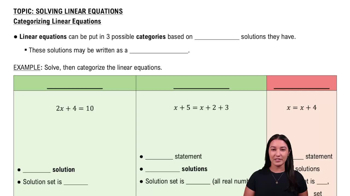
Linear Equations
A linear equation is an algebraic equation in which each term is either a constant or the product of a constant and a single variable. It represents a straight line when graphed. Solving a linear equation involves finding the value of the variable that makes the equation true.
Recommended video:
Categorizing Linear Equations
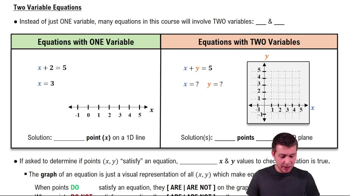
Isolating the Variable
Isolating the variable means manipulating the equation to get the variable alone on one side. This typically involves performing inverse operations such as addition, subtraction, multiplication, or division to both sides of the equation to maintain equality.
Recommended video:
Equations with Two Variables
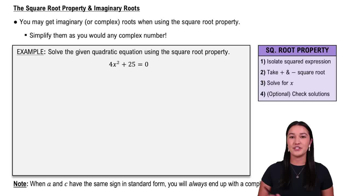
Properties of Equality
Properties of equality state that you can add, subtract, multiply, or divide both sides of an equation by the same nonzero number without changing the equation's solution. These properties are essential for maintaining balance while solving equations.
Recommended video:
Imaginary Roots with the Square Root Property
Related Practice
Textbook Question
1
views
Textbook Question
Find each sum or difference. See Example 1. -6 + (-13)
3
views
Textbook Question
Work each matching problem.
Match each equation in Column I with a description of its graph from Column II as it relates to the graph of y = x².
I II
a. y = (x - 7)² A. a translation to the left 7 units
b. y = x² - 7 B. a translation to the right 7 units
c. y = 7x² C. a translation up 7 units
d. y = (x + 7)² D. a translation down 7 units
e. y = x² + 7 E. a vertical stretching by a factor of 7
3
views
Textbook Question
Find the domain of each rational expression. See Example 1. (x + 3) / (x - 6)
6
views
Textbook Question
Determine whether each relation defines a function. See Example 1. {(5, 1), (3, 2), (4, 9), (7, 8)}
Textbook Question
List the elements in each set. See Example 1. {x|x is a whole number less than 6}