Ch. R - Algebra Review
Lial - Trigonometry 12th Edition
Lial12th EditionTrigonometryISBN: 9780136552161Not the one you use?Change textbook
Chapter 1, Problem 95

Simplify each inequality if needed. Then determine whether the statement is true or false. 2 • 5 ≥ 4 + 6

Verified step by step guidance
1
First, simplify both sides of the inequality separately. On the left side, multiply 2 by 5 to get \(2 \times 5\).
On the right side, add 4 and 6 to get \(4 + 6\).
Rewrite the inequality with the simplified expressions: \(10 \geq 10\).
Interpret the inequality symbol \(\geq\), which means "greater than or equal to."
Determine if the statement \(10 \geq 10\) is true or false by checking if 10 is greater than or equal to 10.

Verified video answer for a similar problem:

This video solution was recommended by our tutors as helpful for the problem above.
Video duration:
1m
Was this helpful?

Key Concepts

Here are the essential concepts you must grasp in order to answer the question correctly.

Order of Operations

The order of operations dictates the sequence in which mathematical operations are performed, typically remembered by PEMDAS (Parentheses, Exponents, Multiplication and Division, Addition and Subtraction). Applying this ensures expressions are simplified correctly before comparing values.
Recommended video:
04:12
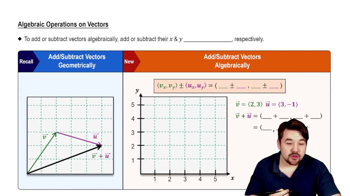
Algebraic Operations on Vectors

Inequality Symbols and Their Meaning

Inequality symbols like ≥ (greater than or equal to) compare two expressions to determine their relative size. Understanding these symbols helps in interpreting whether a given statement about the relationship between two values is true or false.
Recommended video:
5:10
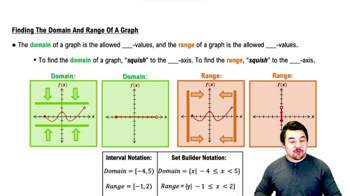
Finding the Domain and Range of a Graph

Simplifying Expressions

Simplifying expressions involves performing arithmetic operations to reduce expressions to their simplest form. This step is essential before evaluating inequalities to accurately compare both sides.
Recommended video:
6:36
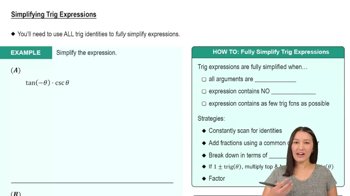
Simplifying Trig Expressions