Ch. R - Algebra Review
Lial - Trigonometry 12th Edition
Lial12th EditionTrigonometryISBN: 9780136552161Not the one you use?Change textbook
Chapter 1, Problem 18

List the elements in each set. See Example 1. {k|k is an odd integer less than 1}

Verified step by step guidance
1
Understand the problem: We need to list all elements of the set defined by \( \{k \mid k \text{ is an odd integer less than } 1\} \). This means all odd integers \(k\) such that \(k < 1\).
Recall what odd integers are: Odd integers are integers that can be written in the form \(2n + 1\), where \(n\) is any integer (positive, negative, or zero). Examples include \(\ldots, -3, -1, 1, 3, 5, \ldots\).
Identify the odd integers less than 1: Since \(k < 1\), we consider all odd integers less than 1. These are \(\ldots, -5, -3, -1\). Note that 1 itself is not included because the inequality is strict (less than 1, not less than or equal to 1).
List the elements explicitly: Write out the odd integers less than 1 in increasing order, for example, \(\{\ldots, -5, -3, -1\}\). Since the set includes infinitely many negative odd integers, it is an infinite set extending indefinitely in the negative direction.
Summarize the set: The set \(\{k \mid k \text{ is an odd integer less than } 1\}\) contains all odd integers less than 1, which are all negative odd integers and zero is excluded because it is not odd.

Verified video answer for a similar problem:

This video solution was recommended by our tutors as helpful for the problem above.
Video duration:
2m
Was this helpful?

Key Concepts

Here are the essential concepts you must grasp in order to answer the question correctly.

Set-builder Notation

Set-builder notation describes a set by specifying a property that its members must satisfy. It uses a variable, a vertical bar or colon meaning 'such that', and a condition. For example, {k | k is an odd integer less than 1} defines all odd integers k that are less than 1.
Recommended video:
06:01
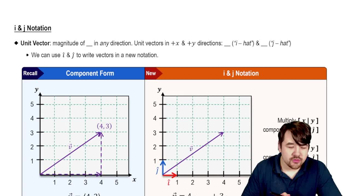
i & j Notation

Odd Integers

Odd integers are whole numbers that are not divisible by 2. They can be expressed as 2n + 1, where n is any integer. Examples include ..., -3, -1, 1, 3, 5, etc. Recognizing odd integers helps identify elements in the set.
Recommended video:
06:19
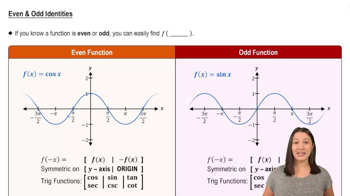
Even and Odd Identities

Inequalities and Number Line

Inequalities describe the relative size or order of numbers. 'Less than 1' means all numbers smaller than 1 on the number line. Combining this with the odd integer condition restricts the set to odd integers less than 1, such as ..., -3, -1.
Recommended video:
3:31
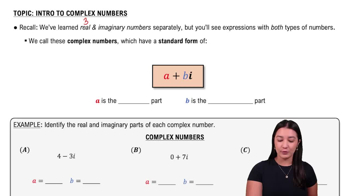
Introduction to Complex Numbers