Ch. R - Algebra Review
Lial - Trigonometry 12th Edition
Lial12th EditionTrigonometryISBN: 9780136552161Not the one you use?Change textbook
Chapter 1, Problem 79

Graph each function. See Examples 6–8. g(x) = ½ x³ - 4

Verified step by step guidance
1
Identify the type of function given. Here, the function is a cubic function of the form \(g(x) = \frac{1}{2}x^{3} - 4\), which means it will have the general shape of a cubic curve but scaled and shifted.
Determine key features of the graph such as the y-intercept. To find the y-intercept, evaluate \(g(0)\): \(g(0) = \frac{1}{2} \times 0^{3} - 4\).
Find some additional points by choosing values for \(x\) (both positive and negative) and calculating the corresponding \(g(x)\) values. For example, calculate \(g(1)\), \(g(-1)\), \(g(2)\), and \(g(-2)\).
Plot the points found on the coordinate plane. This will help visualize the shape of the cubic function, noting that the coefficient \(\frac{1}{2}\) affects the steepness of the curve and the \(-4\) shifts the graph downward by 4 units.
Sketch the smooth curve passing through the plotted points, keeping in mind the typical cubic function shape: it decreases to the left, passes through the y-intercept, and increases to the right, with the curve flattened or stretched according to the coefficient.

Verified video answer for a similar problem:

This video solution was recommended by our tutors as helpful for the problem above.
Video duration:
5m

Key Concepts

Here are the essential concepts you must grasp in order to answer the question correctly.

Understanding Function Notation and Domain

Function notation, such as g(x), represents a rule that assigns each input x to an output value. Understanding the domain, which is the set of all possible x-values, is essential for graphing. For g(x) = ½ x³ - 4, the domain is all real numbers since any real x can be cubed and scaled.
Recommended video:
06:01
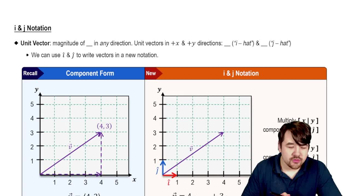
i & j Notation

Graphing Cubic Functions

Cubic functions have the general form ax³ + bx² + cx + d and produce characteristic S-shaped curves. The term ½ x³ indicates the function grows faster for large |x| values, while the constant -4 shifts the graph downward. Recognizing the shape and transformations helps in sketching the graph accurately.
Recommended video:
5:53
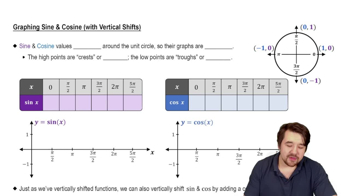
Graph of Sine and Cosine Function

Effect of Vertical Shifts on Graphs

Adding or subtracting a constant, like -4 in g(x) = ½ x³ - 4, shifts the entire graph vertically. This means every point on the cubic curve moves down by 4 units, affecting the y-intercept but not the shape. Understanding vertical shifts aids in correctly positioning the graph on the coordinate plane.
Recommended video:
6:31
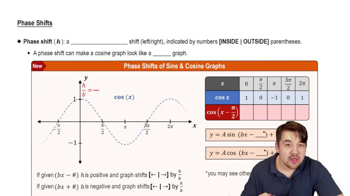
Phase Shifts