Ch. R - Algebra Review
Lial - Trigonometry 12th Edition
Lial12th EditionTrigonometryISBN: 9780136552161Not the one you use?Change textbook
Chapter 1, Problem 52

Give (a) the additive inverse and (b) the absolute value of each number. 0.16

Verified step by step guidance
1
Identify the given number, which is 0.16.
To find the additive inverse of a number, change its sign. So, the additive inverse of 0.16 is \(-0.16\).
Recall that the absolute value of a number is its distance from zero on the number line, always non-negative.
Since 0.16 is already positive, its absolute value is simply \(0.16\).
Summarize: (a) Additive inverse is \(-0.16\), and (b) absolute value is \(0.16\).

Verified video answer for a similar problem:

This video solution was recommended by our tutors as helpful for the problem above.
Video duration:
1m
Was this helpful?

Key Concepts

Here are the essential concepts you must grasp in order to answer the question correctly.

Additive Inverse

The additive inverse of a number is the value that, when added to the original number, results in zero. For any real number x, its additive inverse is -x. This concept is fundamental in solving equations and understanding number properties.
Recommended video:
4:49
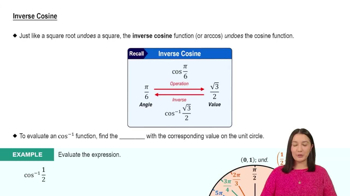
Inverse Cosine

Absolute Value

The absolute value of a number is its distance from zero on the number line, regardless of direction. It is always non-negative. For a number x, the absolute value is denoted |x| and equals x if x is positive or zero, and -x if x is negative.
Recommended video:
7:28
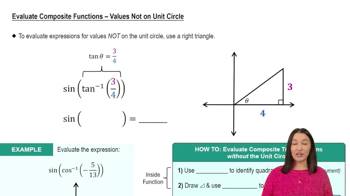
Evaluate Composite Functions - Values Not on Unit Circle

Real Numbers and Their Properties

Real numbers include all rational and irrational numbers and can be positive, negative, or zero. Understanding their properties, such as how additive inverses and absolute values apply, is essential for manipulating and interpreting numerical expressions.
Recommended video:
3:31
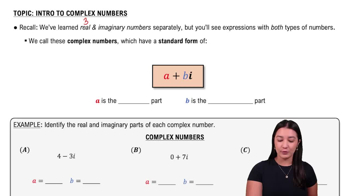
Introduction to Complex Numbers