Ch. R - Algebra Review
Lial - Trigonometry 12th Edition
Lial12th EditionTrigonometryISBN: 9780136552161Not the one you use?Change textbook
Chapter 1, Problem R.6.35

Determine whether each equation is an identity, a conditional equation, or a contradiction. Give the solution set. See Example 4. 2(x - 8) = 3x - 16

Verified step by step guidance
1
Start by expanding the left side of the equation: multiply 2 by each term inside the parentheses to get \(2(x - 8) = 2x - 16\).
Rewrite the equation with the expanded left side: \(2x - 16 = 3x - 16\).
Next, isolate the variable terms on one side by subtracting \$2x\( from both sides: \(2x - 16 - 2x = 3x - 16 - 2x\), which simplifies to \)-16 = x - 16$.
Then, isolate \(x\) by adding 16 to both sides: \(-16 + 16 = x - 16 + 16\), which simplifies to \(0 = x\).
Interpret the result: since \(x = 0\) is the only solution, the equation is a conditional equation with the solution set \(\{0\}\).

Verified video answer for a similar problem:

This video solution was recommended by our tutors as helpful for the problem above.
Video duration:
2m
Was this helpful?

Key Concepts

Here are the essential concepts you must grasp in order to answer the question correctly.

Types of Equations: Identity, Conditional, and Contradiction

An identity is an equation true for all values of the variable, a conditional equation is true only for specific values, and a contradiction has no solution. Recognizing these types helps determine the nature of the solution set.
Recommended video:
04:42
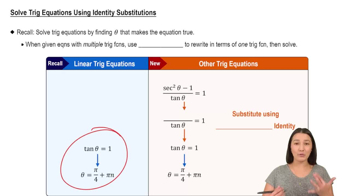
Solve Trig Equations Using Identity Substitutions

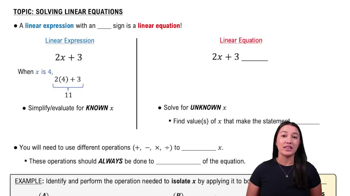
Solving Linear Equations

Solving linear equations involves isolating the variable by applying inverse operations such as addition, subtraction, multiplication, or division. This process helps find the values that satisfy the equation.
Recommended video:
7:48
Solving Linear Equations

Checking Solutions and Solution Sets

After solving, substituting the solution back into the original equation verifies its validity. The solution set includes all values that satisfy the equation, which can be a single value, all real numbers, or an empty set.
Recommended video:
4:02
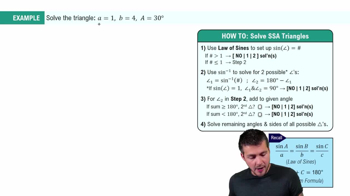
Example 1